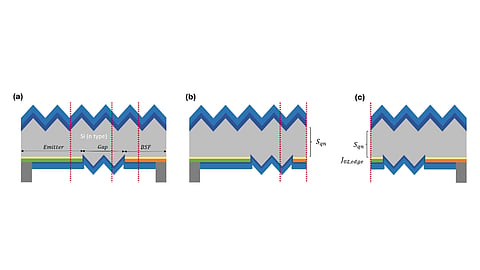


UNSW and DAS Solar researchers investigated how the cutting position affects TBC cells
Cutting through an undoped gap reduced the simulated efficiency penalty by approximately 50% compared with cutting through the emitter
The simulations identified approximately 0.3 mm as the optimum distance between the cut edge and the nearest doped region
Researchers from the University of New South Wales (UNSW) and DAS Solar investigated a lower-loss cutting design for tunnel oxide passivated back-contact (TBC) cells. Cutting cells into smaller sections reduces operating current and resistive losses in module interconnections. However, laser cutting leaves damaged, newly exposed edges where charge carriers can recombine, contributing to cell-to-module losses.
Edge passivation could reduce these losses, but it would add another production step. The researchers therefore examined whether selecting the cutting position within the existing rear-side structure could limit edge losses without requiring this additional treatment. Their simulations show that cutting through a designed gap between the rear emitter and back-surface-field (BSF) regions can reduce the efficiency loss by approximately 50% compared with cutting through the emitter.
TBC cells have alternating emitter and BSF regions on the rear, separated by undoped gaps. This structure allows the cutting line to pass through the emitter, BSF, or gap region.
The researchers used the Quokka3 device-simulation platform to compare these three cutting positions in half, third, and quarter-cell configurations. Based on electrical parameters supplied by DAS Solar, the model represented a 182 mm × 210 mm BC cell with a simulated full-cell efficiency of 26.51%. The researchers said this was consistent with average efficiencies achieved in large-scale BC production.
The cutting position clearly affected cell performance. An emitter-region cut produced the largest efficiency loss because it exposed the junction’s space-charge region at the laser cut edge, increasing carrier recombination. This primarily reduced open-circuit voltage and fill factor. A BSF-region cut avoided exposing the junction and performed better than emitter-region cutting. However, the heavily doped BSF at the exposed edge still resulted in greater recombination than the undoped gap.
The gap region produced the best overall result by separating the exposed edge from both doped regions. Compared with emitter-region cutting, gap-region cutting resulted in a slightly higher short-circuit-current loss because carriers had to diffuse laterally before collection. However, the lower voltage and fill-factor losses outweighed the additional current loss.
Dividing a cell into more pieces creates a greater proportion of cut edge relative to its area. Consequently, the simulated efficiency loss for gap-region cutting at 1,000 W/m² increased from approximately 0.16 percentage points for a half-cell to 0.65 percentage points for a quarter-cell.
Cut-edge-related efficiency losses increased as irradiance decreased. For a quarter-cell with two gap-region cut edges, the simulated efficiency loss increased from approximately 0.65 percentage points at 1,000 W/m² to around 0.94 percentage points at 100 W/m². The researchers attributed this to the greater relative effects of edge recombination and resistance associated with lateral hole transport at lower carrier concentrations.
The researchers also examined the distance between the cut edge and the first doped region. A very narrow gap places the recombination-active edge close to the electrically active region. An excessively wide gap increases the distance carriers must travel before collection, leading to higher short-circuit-current losses.
The simulations identified approximately 0.3 mm as the optimum distance between the cut edge and the nearest doped region. To achieve this, manufacturers would need to incorporate an approximately 0.6 mm-wide undoped gap into the rear-side cell pattern and cut through its center. The researchers found that an off-center cut created unequal gap widths and reduced the cells' combined performance. However, the modeled laser-positioning accuracy of ±0.025 mm suggests that centered alignment may be achievable, although the gap design has not yet been experimentally demonstrated.
The findings provide a possible route to limiting edge recombination without adding another production step. The authors noted that combining gap-region cutting with edge passivation could potentially enable loss-free cell cutting.
The study, titled Simulation of Gap-Region Cutting for Suppressing Edge Recombination Losses in Tunnel Oxide Passivated Back-Contact Solar Cells, was published in Solar Energy.
