
Ricoh plans to establish several hundred megawatts of annual perovskite solar cell manufacturing capacity by 2030, with potential future expansion to gigawatt scale
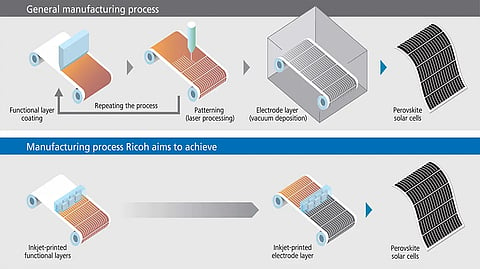
The company aims to use inkjet printing for all functional layers, eliminating laser-processing and vacuum-deposition steps in its proposed process
The project was selected for Japan’s GX Supply Chain Development Support Program, following an earlier consortium project targeting more than 300 MW capacity by 2030
Japan-based Ricoh has announced that it plans to establish several hundred MW of manufacturing capacity for inkjet-printed perovskite solar cells in Miyagi Prefecture by 2030. While it doesn’t provide the specifics, it also foresees potential expansion to gigawatt-scale capacity in the future.
A perovskite solar cell typically comprises several functional layers deposited on a transparent electrode, including an electron transport layer (ETL), a perovskite absorber layer, a hole transport layer (HTL), and a counter electrode. In perovskite-silicon tandem cells, the perovskite cell is integrated with a silicon bottom cell. Mainstream perovskite manufacturing involves various coating techniques such as spin coating or die coating for the ETL, HTL, and perovskite layers, followed by laser processing to remove unwanted coating and vacuum deposition to form the counter electrode.
Ricoh says this approach aims to eliminate the laser-processing and vacuum-deposition steps by pattern-printing all functional layers directly through inkjet printing. This enables precise material deposition where needed, rather than coating a larger area and subsequently removing unwanted material. The process builds on Ricoh’s printing expertise, including inkjet printheads, ink supply systems, and printing-system technology.
This approach also improves material utilization and streamlines manufacturing, increasing productivity and reducing production costs, adds Ricoh.
The company also plans to leverage the technology availability in high-speed printing and substrate-transport technologies to print continuously on roll-shaped substrates. This can support higher productivity and lower-cost production of perovskite solar cells through patterned inkjet printing.
The project has been selected for support under Japan’s GX (Green Transformation) Supply Chain Development Support Program, administered by the Ministry of Economy, Trade and Industry (METI). This follows an earlier project involving Ricoh, Daiwa House Industry, and NTT Anode Energy, which was selected for Japan’s Green Innovation Fund in September 2025. The consortium aims to develop inkjet-based production technology alongside building installation and electrical-system integration, targeting annual manufacturing capacity exceeding 300 MW and a power-generation cost of ¥14/kWh by 2030.

