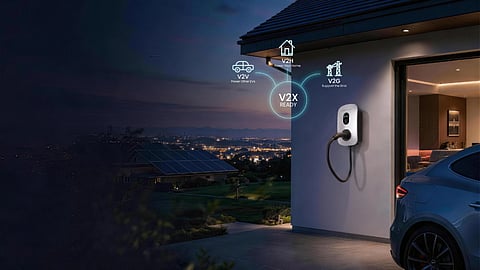


Sigenergy’s EVAC G2 supports bidirectional power transfer in addition to meeting the upcoming EU communication requirements
The charger integrates with solar and battery storage systems and can use a compatible EV battery to restart the home energy system during a power outage
For commercial applications, up to 100 chargers can operate in parallel without the need for external energy management controllers
Energy storage system manufacturer Sigenergy has announced more details about its second-generation electric vehicle (EV) charger, the Sigen EVAC G2, ahead of new European Union (EU) charging infrastructure requirements coming into effect in 2027.
Starting January 1, 2027, new AC charging points in the EU must support the ISO 15118-20 communication standard under the Alternative Fuels Infrastructure Regulation (AFIR), Sigenergy explains. The regulation does not require chargers to transfer electricity in both directions. However, the company's EVAC G2 offers this functionality.
According to the datasheet, the EVAC G2 comes in three nominal charging power ratings: 7 kW, 11 kW, and 22 kW. The 7 kW version supports single-phase charging, while the 11 kW and 22 kW versions support 3-phase charging. With an IP65 protection rating, the charger is suitable for indoor and outdoor installation and operates at temperatures between -30°C and 55°C.
The charger works with the company's energy systems, including SigenStor Neo. The residential storage system offers an inverter output of up to 15 kW and a storage capacity of up to 45 kWh. The charger communicates with the PV system and battery in real time, allowing excess solar power to be used for EV charging (see Sigenergy’s Residential Storage With Integrated Design And Backup Features).
For faster charging, the system can draw power from both the grid and the PV system at the same time, with additional power from the stationary battery. Its artificial intelligence (AI)-based energy management software (EMS), SigenAgent, determines charging times based on solar forecasts, electricity tariffs, battery charge levels, and household consumption (see Sigenergy Launches AI Agent For Solar & Storage).
Through vehicle-to-home (V2H) functionality, a compatible EV can supply electricity to the household during a grid outage. The charger is also hardware-ready for vehicle-to-grid (V2G) operation, although activation requires support from both the grid and the vehicle.
Another feature is black-start capability. If the home battery runs out of energy during a prolonged outage, the charger can restart the entire home energy system using the EV battery.
For commercial applications, up to 100 chargers can operate in parallel with integrated energy management, eliminating the need for external controllers. An integrated Measuring Instruments Directive (MID)-compliant meter records electricity consumption for billing purposes, such as company car charging. The charger also features a display that provides real-time charging information and supports QR code-based payments.
Sigenergy has offered bidirectional DC chargers since 2024, and the company reports that thousands of customers currently use them.