

Key takeaways:
Silver-coated copper remains the primary pathway for reducing metallization costs in HJT manufacturing
Manufacturers have significantly lowered silver content in pastes while maintaining electrical performance
Future development is focused on balancing material costs, printing performance, throughput, and long-term reliability
The topic of metallization has long been on the radar for solar cell manufacturers. It plays a crucial role in reducing cell production costs. It is also the reason why manufacturers still have roadmaps targeting silver reduction in metallization.
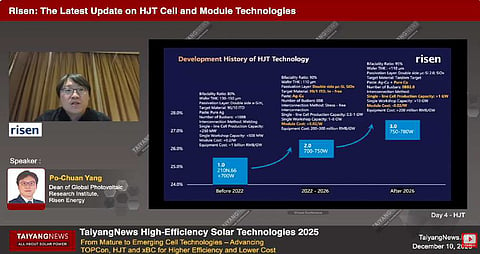
The most significant ongoing development is the silver-coated copper. Although this topic was also addressed in earlier editions of the TaiyangNews Cell & Module Technology Trends report, efforts to reduce silver content in the paste continue. Currently, silver usage has been cut by 70%. Ultimately, these improvements result in module power ranging from 700 W to 750 W. Additionally, they lower costs, with the module cost now only about RMB 0.02/W higher than that of mainstream TOPCon products, according to Po-Chuan Yang of Risen Energy. This price difference is expected to decrease further, especially if silver prices rise.
Christian Comes, Huasun’s Head of Business Development Europe, in his presentation on heterojunction technology (HJT) at the TaiyangNews High-Efficiency Solar Technologies Conference 2025, also highlighted the latest innovations at the cell level. He explained that improved CVD processes produce higher-quality p-n junctions, leading to better efficiency. The next goal is to cut indium use by developing better TCO materials. In terms of manufacturing, emphasis was placed on enhancing the texturing process. A key factor influencing both costs and performance is metallization; naturally, the key development area here is reducing silver consumption. However, Comes noted that specifics of these advancements are protected by IP, including those of the company’s partners, and thus were not discussed in detail.
However, the need to save on silver to reduce the costs is no secret. The key theme for HJT is cost reduction without losing the performance edge. Metallization is the key cost driver of any cell architecture, not just HJT, and silver reduction is a common strategy. The solutions, however, are different. For HJT, silver-coated copper has long been produced, and the silver content has consistently decreased.
Kaining Ding, Head of PV-Thync Lab, Forschungszentrum Jülich, during his keynote on Status & Outlook of HJT at the TaiyangNews High-Efficiency Solar Technologies Conference 2025, estimated that the content of silver in HJT metallization pastes is about 10% on the rear and 25% on the front, which is considerably reduced over the years. Risen’s CTO Yang provides further details. The company’s copper paste roadmap demonstrated a 70% reduction in silver consumption from 60% to 15%, while maintaining resistivity, over the last 4 years. Looking ahead, the critical challenges are securing a paste supply at a reasonable price and with stable quality and printing speed. It needs to strike the right balance among fine-line printing, throughput, and reliability, ensuring long-term stability against oxidation. As for pure silver consumption, it decreases from 10 mg/W to 3.9 mg/W for HJT, while improving module power from 700 W to 740 W. The company linked this progress to the industrialization of silver-copper paste and finer metallization, as part of its broader HJT optimization strategy.
The text is an edited excerpt from TaiyangNews’ report on Cell & Module Technology Trends 2026, which can be downloaded for free here.
