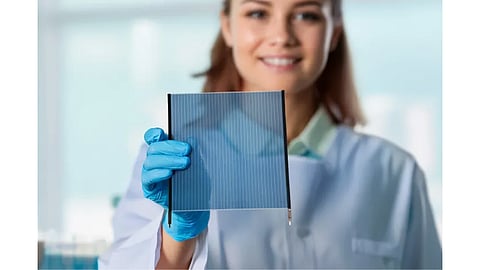


HeiQ, Brilliant Matters and Forschungszentrum Jülich’s Solar Factory have demonstrated semi-transparent organic photovoltaics compatible with roll-to-roll manufacturing
Silver nanowire electrodes offer an alternative to visible silver grids, with low-temperature printing supporting their use on flexible materials
Prototypes achieved efficiencies above 11%, with potential uses in solar windows, greenhouse glazing, and other architectural products
Canadian organic photovoltaic (OPV) developer Brilliant Matters has integrated HeiQ’s silver nanowire transparent electrodes into BM10, its next-generation OPV platform. Working with Forschungszentrum Jülich’s Solar Factory, the companies also demonstrated the combined technology’s compatibility with roll-to-roll manufacturing.
According to the announcement, semi-transparent OPV prototypes using the electrodes achieved power conversion efficiencies above 11%. The manufacturing demonstration took place at Solar Factory under the EU’s EMERGE project, producing flexible, semi-transparent PV modules.
In semi-transparent OPV, electrodes need to collect electrical current while allowing light to pass through. Their design affects both power generation and appearance in products such as solar windows. HeiQ’s coating contains a fine network of metal wires within a transparent, flexible material, combining electrical conductivity with light transmission. Brilliant Matters says this technology offers an alternative to silver grid electrodes commonly used in OPV panels.
Varun Vohra, Engineering Department Manager at Brilliant Matters, described the technology as ‘enabling completely invisible current collectors’, giving designers more freedom to integrate solar power into their products. He said the company tested several silver nanowire materials before working with HeiQ to develop a solution that met BM10’s requirements for transparency, conductivity, and manufacturing.
The coating’s printing properties also matter for production. According to HeiQ, it can be printed at low temperatures, making it suitable for materials and solar-cell layers that could be damaged by excessive heat. The company says it can be used to print both top and bottom electrodes as alternatives to opaque electrodes or those deposited by sputtering.
Roll-to-roll processing applies materials to a flexible sheet as it moves between rolls. Compatibility with this approach provides a route toward continuous module production. The BM10 demonstration therefore connects the electrode’s transparency and conductivity with a process suited to larger-scale manufacturing.
Potential applications include solar windows, greenhouse glazing, and other architectural products. OPV’s lightweight, flexible format and adjustable transparency could help integrate power generation into surfaces where conventional solar modules are difficult to install. An example of OPV window integration is NEXT Energy Technologies’ pilot façade installation at its US headquarters (see NEXT Energy Installs BIPV Façade With Organic PV Coatings).
For commercialization, the collaboration aims to meet a ‘10-20’ benchmark: more than 10% efficiency and over 20 years of operating life. The prototypes exceed the efficiency threshold, while the 20-year operating life remains a development target.
The companies, along with Solar Factory, will continue developing the BM10 platform, HeiQ Xpectra electrodes and manufacturing processes for building, infrastructure. and other applications where appearance matters.
Brilliant Matters was founded in Canada in 2016 and develops OPV materials and devices. Solar Factory is a research group within the Institute of Energy Materials and Devices – Photovoltaics (IMD-3) at Forschungszentrum Jülich. It develops manufacturing processes for emerging PV technologies.
