
Key takeaways:
LECO enables a significant reduction in front-side contact recombination by lowering J₀,metal values
Lower firing temperatures and aluminum-free pastes help preserve passivation and limit contact damage
Changes in contact morphology reduce the effective metal-silicon interaction area, significantly reducing the effective J₀,metal
Laser Enhanced Contact Optimization, or LECO, has played a significant role in TOPCon’s current status as a mainstream technology. This is because LECO helps reduce emitter-contact recombination on the front side, thereby reducing J₀,metal, thereby enhancing efficiency.
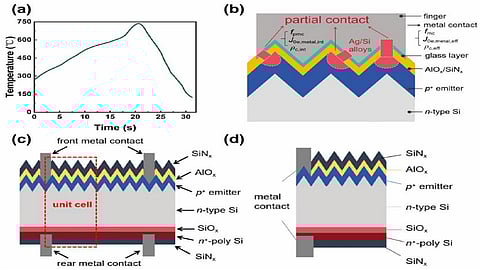
A study on the mechanism underlying this efficiency enhancement using LECO has been carried out by a team of researchers from the University of South Wales, Sydney (UNSW), NCU-GQC Institute of PV-HE-ES Technology, Jiangxi, China, Institute of Photovoltaics, Nanchang University, and Laplace Renewable Energy Technology, Shenzhen. The study conducts simulations that reveal the behavior of boron in the emitter region, the effects of temperature during firing, and the morphologies of metal-silicon contacts.
TOPCon has fairly good passivation on the rear side with tunnel oxide and poly-Si layers, resulting in low contact resistance and surface recombination due to the carrier-selectivity feature of the doped poly-Si. On the front side, the metal has to make contact with the emitter, which is crystalline silicon doped with boron (P-type). At firing temperatures, the glass frit in the metallization paste etches the nitride and aluminum oxide layers, forming contact with the emitter layer. There has been extensive optimization of the front-side metallization process and materials to reduce contact resistance and recombination losses. LECO is the latest optimization technique for the front side and is currently a mainstream process used in TOPCon cell lines.
Earlier studies showed that reducing the peak firing temperature decreased J₀,metal from 1,656 to 761 fA/cm². With LECO and a specialized silver paste, this is further reduced to 206 fA/cm², compared to 503 fA/cm² with conventional high-temperature firing. Simulation studies based on the annealing time-temperature curve confirm that the boron profile remains unchanged after firing. Therefore, the mechanism underlying the reduced J₀,metal is attributed to the reduced corrosiveness of the glass melt on the passivation layer at lower firing temperatures. The aluminum-free specialized paste exhibits minimal penetration into the passivation layer during firing, preventing damage to the passivation and emitter layers. Further, LECO enables the formation of bowl-shaped Ag-Si nano-alloys with narrower corrosion pits than those formed by conventional high-temperature firing and without LECO. This reduces the ratio of actual Ag-Si contact area to the total area of the printed finger, denoted by fₚmc. This results in a significant reduction in the effective J₀,metal on the front side.
Other factors, such as boron concentration profiles, selective emitter, and further reduction and optimization of fₚmc, were simulated as part of this study, titled Simulation Insights Into Enhanced Emitter Contact Passivation via LECO on Industrial TOPCon Solar Cells.

