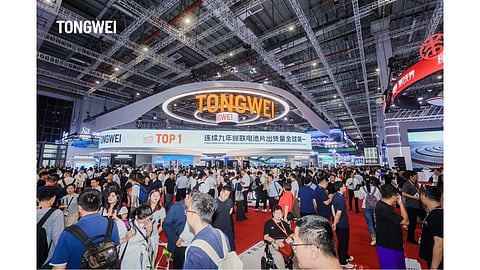


Tongwei Solar displayed its newly launched TNC 3.0 TOPCon modules at SNEC 2026, stating it has started global deliveries of the product
The new modules offer up to 770 W output, 24.8% efficiency, and features aimed at boosting energy yield and reliability
Tongwei says the platform can improve energy yield and reduce LCOE by around 3%
Chinese solar manufacturer Tongwei Solar is showcasing its recently launched TNC 3.0 module series at SNEC 2026, which the company says is designed to deliver higher energy yields and stronger project economics through a combination of cell and module-level innovations.
The TNC 3.0 platform, unveiled in May 2026 and now entering global deployment, builds on Tongwei's TOPCon technology roadmap. The company said the new modules are currently available in 2 variants: a 770 W G12-66 module, and a 670 W G12R-66 module, both with conversion efficiencies of up to 24.8%.
These integrate a 4-cut (quarter-cut) cell design, upgraded n-type cells, enhanced bifacial performance, and improved temperature characteristics to increase lifetime power generation.
According to the company, the 4-cut design divides the cell’s operating current into 4 parts, reducing internal power losses and saving more than 4 W compared with conventional half-cell products. It also uses 360° 3-dimensional passivated cells with passivation applied to the front, back, and even the sides to provide protection, boosting cell efficiency to over 26.3%, compared to 25.5% for conventional TOPCon cells.
It also uses louvered (shingled) interconnect technology that eliminates approximately 0.6% of the ineffective power generation area within the module. This is equivalent to fitting 0.4 more cells into a module of the same size, resulting in a power gain of over 5 W, it explains.
Tongwei emphasized that TNC 3.0 modules can achieve up to 90% bifaciality in certain configurations and feature a temperature coefficient of -0.26%/°C. Additional design changes have been incorporated to improve performance under low-light conditions, reduce annual degradation, and limit hotspot formation during partial shading events.
The company added that higher energy yield, combined with lower transportation and balance-of-system (BOS) costs, could reduce the levelized cost of electricity (LCOE) by around 3%, depending on project configuration.
Speaking at SNEC 2026, Tongwei Solar CTO Guoqiang Xing said the solar sector may see softer demand growth in 2026 as market reforms in China, trade restrictions in traditional markets such as Europe and the US, and grid constraints in some overseas markets affect project development. However, he is confident about the industry's long-term outlook, supported by declining solar and storage costs and growing electricity demand from artificial intelligence and data-center infrastructure.
He described the TNC 3.0 launch as part of the company's broader strategy to improve customer value through higher efficiency, reliability, and energy production.
Recently, Tongwei’s Global Innovation R&D Center announced that its THC-G12 HJT module achieved a certified output power of 802.43 W and a full-area conversion efficiency of 25.83%, according to testing by TÜV Rheinland. Xing stressed that the result marks the 12th power record set by the module series since its launch and establishes a new benchmark for crystalline-silicon module performance.
Xing said the achievement reflects the company’s ongoing focus on technological innovation, which is something it continues to prioritize during the industry's current downturn. As part of this strategy, alongside TOPCon and HJT, Tongwei is also investing in back-contact (BC) and perovskite-silicon tandem technologies.
