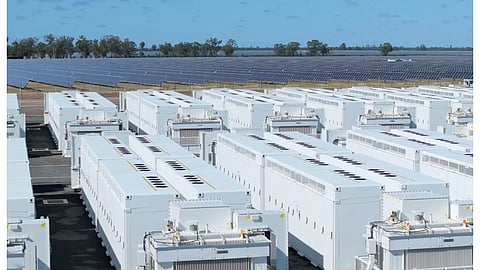


SolarPower Europe has published new reports outlining the best practices for large hybrid solar PV and BESS projects
The new Technical Due Diligence Best Practice Guidelines handbook covers all project phases – from feasibility studies and financing to construction, operation, and eventual decommissioning of hybrid solar PV and BESS systems
It stresses robust technical reviews by independent advisors at every stage to ensure long-term reliability, sustainability, and bankability of hybrid projects
The 3rd edition of the EPC Best Practice Guidelines includes enhanced recommendations on engineering and climate risk considerations
The guidelines call for biodiversity protection, ecological surveys, waste planning, and stronger cybersecurity measures
As the global build-out of hybrid solar PV and battery energy storage systems (BESS) accelerates, SolarPower Europe (SPE) has released 2 new reports that recommend best practices and outline the due diligence framework for such facilities before they begin commercial operations.
The Technical Due Diligence Best Practice Guidelines for Hybrid Utility Scale Solar PV and Battery Energy Storage Systems is a new guideline handbook from SPE. It attempts to serve as a complete guide to evaluate full-lifecycle feasibility, bankability, and performance, and grasp the complexity of solar and BESS projects.
To assess utility-scale solar PV and BESS projects, the guidelines recommend selecting the right technical advisor to conduct due diligence during phase 0. The guidelines cover the entire gamut from conducting the pre-developing/feasibility studies under phase I, contracting and supply chain under phase 2, financing and governance under phase 3, construction and commissioning under phase 4, to operation and resilience under phase 5, finally ending with revamping/repowering and decommissioning.
Robust ‘health checks’ by technical advisors or independent engineers are a must across all these phases, stressed SPE. These help maintain the integrity, viability, sustainability, and long-term reliability of hybrid systems.
The association has also released its 3rd edition of the Engineering, Procurement & Construction Best Practice Guidelines Version 3.0 with a view to offering guidance to improve the quality of large-scale hybrid solar PV systems.
One of the main components of the latest version is expanded guidance on hybrid solar PV and BESS projects for their engineering, delivery, and operational interfaces.
The guidelines recommend that project owners embed biodiversity protection and factor in waste considerations in the projects, starting from the location itself. While PV projects built on biologically degraded sites help significantly improve biodiversity, projects can come up on other suitable sites provided due diligence is conducted in the form of an initial ecological survey followed by other studies so as to accurately map the ecosystem for native plants and animals.
Similarly, cybersecurity must also be a point of focus since hybrid systems depend on digital control and monitoring. Strong digital protection in terms of secure logins and separated networks can be ensured to stop any external interference with control systems.
The updated edition also expands the guidance on risk management, including bankability, country and regulatory risks, climate risk, and incorporates Health, Safety, Security and Environment (HSSE) approach.
“Quality hybrid solar and battery storage projects are powering Europe’s clean energy. These landmark reports will support the sector in building and maintaining high-calibre hybrid solar projects with flexibility and confidence, while driving Europe’s solar transformation forward,” said SPE CEO Walburga Hemetsberger.
