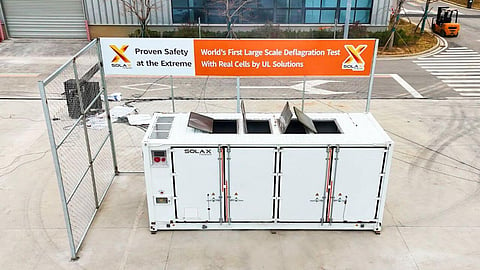

SolaX’s conducted a deflagration test on its ORI 5MWh ESS, according to the proposed UL 9540A:2025 testing framework
UL was responsible for test design, execution, and technical assessment
The ESS’s enclosure didn’t show any significant deformation after the test, while the explosion release mechanism activated successfully
SolaX Power, a provider of PV inverters and energy storage solutions, has tested its SolaX ORI 5MWh series lithium iron phosphate (LFP)-based containerized battery energy storage solution (BESS) to mitigate deflagration hazards during battery thermal runaway.
A deflagration test for an ESS is a large-scale safety assessment that measures how an enclosure handles the rapid pressure rise caused by the ignition of flammable gases produced during battery thermal runaway. These tests validate safety features like deflagration panels or vents that effectively release explosion pressure without causing catastrophic structural failure. This test was conducted under the proposed UL 9540A:2025 testing framework, while test design, execution, and technical assessment were done by UL Solutions. According to the company, this is the first system-level deflagration test carried out anywhere around the globe by UL under the proposed framework.
The test was designed to replicate severe failure scenarios associated with LFP battery installations. Under controlled conditions, real battery cells were deliberately driven into thermal runaway while the system’s emergency ventilation remained closed. This allowed the test to simulate the complete sequence of flammable gas release, accumulation, and deflagration, covering critical risk mechanisms used in system-level safety evaluation. The testing agency, based on simulation modeling, also planned the test site layout, system configuration, and operating conditions to reproduce a critical safety scenario. To generate strong pressure waves and flame turbulence, which increases stress on the enclosure’s structural integrity and pressure-relief mechanisms, the lab positioned the trigger cell accordingly. It also incorporated redundant ignition sources and a carefully defined trigger mechanism to ensure consistent and reproducible test conditions.
Observations indicated that the system’s safety features (pressure relief structure) were activated in line with design expectations; however, container doors remained closed and showed no significant deformation during the deflagration event. The enclosure maintained structural integrity without rupture, and no internal components or fragments were ejected. In addition, no secondary hazards to surrounding personnel or the environment were reported.
According to UL’s technical assessment, the test placed substantial stress on both the structural and functional safety systems of the energy storage container, providing useful reference data for understanding system-level safety limits in large-scale BESS installations.

