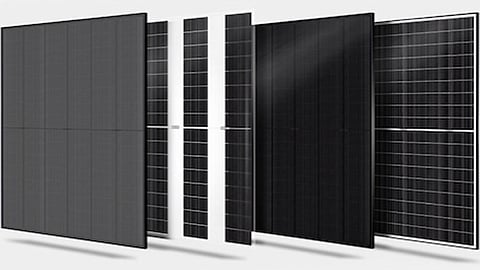

SoliTek has upgraded its residential and commercial rooftop application modules to a peak output of 455 W, from 435 W
Its anti-glare module with a satin surface front glass has gained a power output of up to 10 W, reaching 445 W
The company also adopted heat-strengthened front glass, replacing tempered alternatives, across the module portfolio
Lithuanian PV module maker SoliTek has updated its residential and commercial & industrial (C&I) focused products with higher power output, improved efficiency, and customized PV glass.
The company classifies its BLACKSTAR and SOLID series as ‘standard’ products for residential and commercial rooftop applications, while the Satin Surface glass-based modules are categorized as an anti-glare application product. The company promotes its MAGNUS series for C&I use cases.
The latest residential and commercial rooftop PV modules use 96 G12R (182.2 × 210 mm) TOPCon half-cut cells, rated for a maximum power output of 455 W and an efficiency of 22.77%. In comparison, the existing models, equipped with 108 M10 (182.2 × 182.2 mm) half-cut cells, are rated for lower power output and efficiency of 435 W and 22.27%, respectively. According to the company, these gains are attributable to the former’s (module) larger active area of 1,762 × 1,134 × 30 mm with respect to the latter’s 1,722 × 1,134 × 30 mm and a higher average rated cell efficiency (unquantified).
The company also follows a similar G12R layout for its new anti-glare modules. It incorporates micro-textured front glass to reduce specular reflection to under 3,600 cd/m², reducing glare while maintaining high optical transmittance throughout a sunny day. The company states that it has gained a power output of up to 10 W, reaching 445 W, compared to the earlier model’s 430 W. These modules are promoted for glare-sensitive environments such as airports, highways, railway corridors, and urban rooftops.
In addition to residential and anti-glare applications, the company’s module for C&I applications reaches a power output of up to 510 W, up from 505 W previously, attributable to upgrades similar to those discussed above. It achieves a maximum efficiency of 22.93%.
In terms of PV material optimizations, SoliTek introduces front glass, built via a heat-strengthening process, replacing tempered glass across its module range. The company states that the former glass differs from the latter in terms of its fracture behavior, forming larger fragments that are more likely to remain in position during breakage. Without specifying the data, the company claims that it maintains the module’s current certified mechanical load resistance and hail resistance. It also supports lamination with a polyolefin (POE) encapsulant for glass-glass PV modules.
While not disclosing a timeline, the company states these new module ranges will be commercially available to its partners across all served markets throughout Europe.

