
Key takeaways:
Sticky Solar’s The Tape Solution replaces conventional soldering during the stringing process
The TS5000 features dual cassette loading and a throughput of 5,000 cells per hour in a single-lane configuration
The company demonstrated the technology for both back-contact and bifacial TOPCon cells
The mainstream method for interconnecting cells in the module assembly line is to solder the ribbons to busbars. The high soldering temperatures are not ideal for some cell technologies, leading equipment manufacturers to explore alternative approaches. The Tape Solution (TTS) from Sticky Solar Power is one such method, in which ribbons are placed along adhesive tape that is stuck to the cells in a pattern, so that the interconnection is achieved at a later stage.
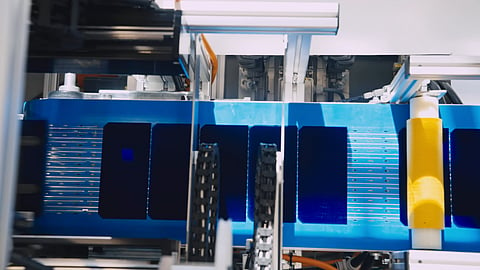
The Sweden-based company developed a proprietary tape to fix the copper wires or ribbons onto it. After the wires are attached to the tape in a tool specified for that purpose, they are spindled and used in the company’s stringer, TS5000, for attaching cells into strings. These cell strings are only mechanically attached, while the actual interconnection occurs at the lamination stage, completing the electrical connection. The TS5000 features dual cassette loading, which enables continuous operation and can process 5,000 cells per hour in a single-lane configuration. It includes an inbuilt vision camera for cell inspection. TaiyangNews has covered TTS and the tool in detail here: Tape-Based Interconnection Approach For BC Modules.
TTS especially offers an advantage for back-contact cell interconnection, where mainstream soldering at around 240°C induces cell warpage after tabbing and stringing. Jonas Buddgard, founder of Sticky Solar Machinery, emphasized during a discussion with TaiyangNews that the company has also demonstrated its solution for mainstream bifacial TOPCon cells. Buddgard also states that the solution is tandem-ready.

