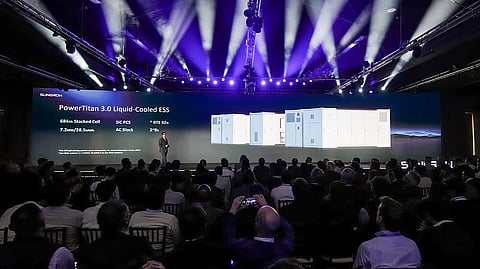

Sungrow’s latest PowerTitan series BESS combines vertically stacked battery racks and multiple PCSs in a 20 ft container
Each container is rated for a power output of 1.78 MW and a storage capacity of up to 7.12 MWh
It also offers utility-scale grid-forming functionality
Sungrow, a global provider of PV inverters and battery energy storage solutions (BESS), has unveiled the latest PowerTitan 3.0 BESS, targeted at Europe’s growing utility-scale storage market.
The company says this BESS combines vertically stacked battery racks and multiple power conversion systems (PCS) in a 20 ft container, rather than a traditional distributed configuration. This ‘AC Block’, equipped with battery packs with more than 600 Ah battery cells and 4 vertically stacked PCSs, is rated for a 1.78 MW power output (3-phase) and 7.12 MWh of storage capacity, supporting continuous operation (charging/discharging) for up to 4 hours. These containers can be connected in parallel (electrically) and installed in a 15 cm back-to-back layout for up to 6 units, making individual blocks of 7.2 MW/28.5 MWh capacities for a large-scale storage project (GW-scale) in Europe. The company claims that for a 1 GW project, this layout offers a power density of 483 kWh/m² within a 6,951 m² area, reducing construction cost by up to 20% compared to alternative solutions. In addition, this BESS can be installed and commissioned within 1 hour due to its built-in PCS and factory-assembled, pre-commissioned container design. The company notes that it further enables the commissioning of a 1 GWh project in less than 12 days.
Instead of IGBT-based PCSs, this BESS adopts silicon carbide (SiC) based alternatives (450 kVA capacity/unit) that provide a higher (unquantified) bidirectional conversion efficiency of 99.3%. As a result, it also boosts the system's round-trip efficiency (RTE) to 92%, making the most out of the stored energy. Besides, these PCSs feature automated state-of-charge (SoC) calibration with an estimation error under 3% across block and rack level, eliminating SoC imbalances in real-time. According to the company, this attribute enables up to 8% additional discharge of stored energy compared to conventional counterparts.
From the perspective of applications in Europe’s regional utility storage market, this product, with a built-in grid-forming function, supports ancillary services, such as blackstart, grid frequency support, electricity arbitrage, and backup, for critical loads like data centers.
The company incorporates a cooling mechanism based on circulating liquid coolant. Replacing the wounded type of battery cells with a stacked one eliminates corner stress, reduces internal resistance, and lowers failure risks such as lithium plating, internal short circuits, and thermal runaway, the company claims.

