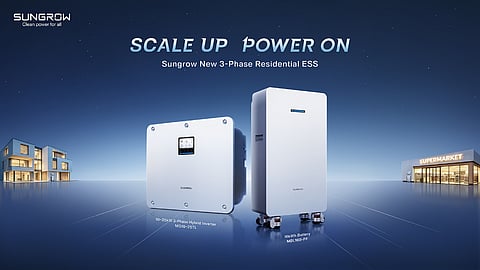

Sungrow introduces its latest MGTL hybrid inverter series, targeting residential and commercial applications
This inverter, which supports up to 200% PV oversizing and connects with either in-house or third-party batteries, can maximize users’ PV self-consumption
During a grid blackout or scheduled load shedding, it provides emergency backup even with an unbalanced load distribution
According to the company, this inverter series is rated for an operating noise-level range of 35 to 45 dB
Leading PV inverter and energy storage system (ESS) maker Sungrow has launched its latest 3-phase MGTL series hybrid inverter range (MG10 - 25TL) for residential and small commercial consumers.
The company says the product's key features are maximizing PV self-consumption, strengthening energy resilience, and user-friendly system configuration.
This inverter series features 3 MPPT channels, each rated at a maximum PV current of 20A, and is designed to deliver a power output range (AC) of 10 to 25 kW at 400 V. According to the company, it supports up to 200% DC/AC oversizing relative to the rated full-load capacity. The inverter supports a maximum PV system voltage of 1,000 V.
It can transmit charging or discharging current (DC) of up to 400 A (for MG20/25TL) and 330 A (for MG10/12/15TL models) when connected to storage. While the product datasheet doesn’t mention the maximum storage capacity it supports, the company emphasizes supporting an open battery ecosystem that includes Sungrow’s MBL120 and 160 series and third-party systems.
In on-grid mode, the PV power first meets captive demand and any excess is channeled to storage, maximizing PV self-consumption. Often, this clean energy is not enough to fully charge storage, so the grid supplies the remaining rated capacity. This storage is primarily intended to provide emergency backup at a rated full-load power output range of 10 to 25 kW during a grid outage. The inverter switches to off-grid mode almost immediately after receiving a grid outage command. The backup duration always depends on the maximum storage capacity. During this time, the inverter supports loads unevenly distributed across three phases (such as Phase A: 20 kW, Phase B: 5 kW, and Phase C: 0 kW). According to the company, the 10-, 12-, and 15/25 kW models support up to 200%, 180%, and 150% unbalanced loads, respectively, compared to their rated full-load capacities. This feature allows system stability irrespective of how the end user’s power draw shifts, boosting the user’s energy resilience. This inverter has a rated maximum conversion efficiency of 98%.
On the system side, it integrates multiple function ports dedicated to a diesel generator, ‘smart’ household appliances, and batteries. Sungrow uses a fanless thermal regulation mechanism with an operating noise level below 35 dB for MG10/12/15L models, while the noise level is 10 dB higher for MG20/25TL. The company says that the performance at these levels is ‘ultra-quiet’.
The company highlighted its arc-fault circuit interrupter (AFCI 3.0R) and dual pressure-relief valve design among the safety features. The inverter is housed in an IP66-rated cabinet for indoor and outdoor installations. Its enclosure or coating is rated C5, designed to withstand high environmental corrosion in coastal or high-salinity regions.
Users can monitor and manage these operations in real time by installing Sungrow’s remote monitoring app, iSolarCloud, on their smartphones. They can also monitor and track operational data through the inverter’s 4.3-inch touchscreen locally.

