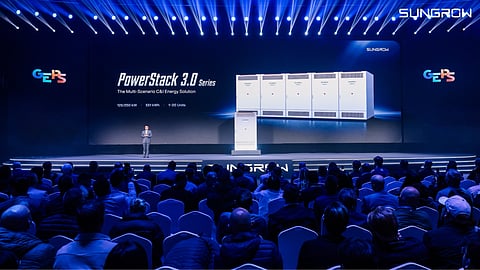


Sungrow has launched PowerStack 3.0, a modular C&I ESS for standalone storage, solar-plus-storage, EV charging and microgrid applications
The system uses 684 Ah battery cells and a silicon carbide (SiC) power conversion system, with over 92% round-trip efficiency
Sungrow reports a 43% reduction in installation footprint for a 5 MWh system compared with its previous generation
Sungrow has expanded its commercial and industrial (C&I) energy storage portfolio with a new modular battery storage system called PowerStack 3.0. The new system, presented at the Global Energy Pioneer Summit 2026, can be configured for solar PV, battery storage, EV charging, and microgrid applications.
The system supports both 2-hour and 4-hour storage configurations. In solar-plus-storage applications, the system uses a common power conversion system (PCS) for both solar PV and battery storage. According to Sungrow, this removes the need for a separate solar inverter and allows the two systems to share a DC connection. The EV charging module extends this arrangement to charging equipment. For microgrid applications, Sungrow says the system can switch from grid-connected to off-grid operation without interruption, eliminating the need for a separate static transfer switch.
PowerStack 3.0 uses 684 Ah stacked battery cells and Sungrow’s silicon carbide (SiC) PCS. The company reports a peak PCS conversion efficiency of 99.2%, while the system’s round-trip efficiency exceeds 92%. The system offers an installation energy density of up to 256 kWh/m². According to Sungrow, a 5 MWh installation requires 43% less space than the previous generation. Up to 20 units can be connected in parallel. It has an IP55 protection rating and C5 corrosion resistance, with an operating temperature range of -30°C to 50°C. The company has also included 3-level fuse protection and a 4-layer fire safety system.
Sungrow has integrated its AI assistant, Bubbly, into the platform to support project planning, commissioning, and operation. During operation, it uses solar generation and electricity demand forecasts to manage battery charging and discharging. Sungrow claims this can improve returns by more than 12% compared with conventional self-consumption operation.