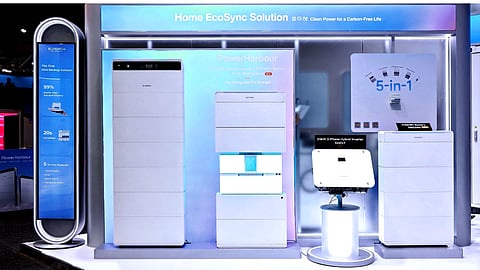


Sungrow introduced its PowerHarbour residential ESS to Australia at All-Energy Australia 2026
The system supports battery expansion up to 120 kWh, with stackable modules designed to simplify future capacity upgrades
Selected PowerHarbour Pro models integrate EV charging, while AI-based energy management helps schedule battery charging and discharging
PV inverter and energy storage system (ESS) provider Sungrow has brought its PowerHarbour residential ESS to Australia, presenting it at All-Energy Australia 2026. The system was previously introduced in Europe and is now being offered to Australian households. It combines a hybrid inverter, battery storage, and energy management in one platform.
Sungrow highlights AI-based energy management and flexible battery capacity among the product’s features. PowerHarbour uses weather forecasts, expected solar generation, household consumption patterns, and electricity prices to plan when the battery should charge or discharge. This allows the system to consider both solar availability and changing electricity tariffs.
PowerHarbour supports up to 200% PV oversizing in applicable configurations, claims the company. Storage capacity can reach 120 kWh when additional battery clusters are connected. The system uses battery cells rated at 314 Ah or higher, with each stackable module rated at up to 10 kWh. According to Sungrow, users can add new modules without SOC calibration or pre-charging.
Another feature highlighted for Australia is integrated electric vehicle (EV) charging. Selected PowerHarbour Pro configurations combine EV charging hardware with the inverter and an energy management system. Sungrow is also positioning the platform for future vehicle-to-everything (V2X) applications, although the SHSA-Pro model is marked as ‘coming soon’ and V2X functionality remains subject to market availability and compatibility.
For outdoor installations, PowerHarbour offers IP66 protection and C5 corrosion resistance. Depending on the configuration, the system measures as little as 255 mm in depth and operates at noise levels below 30 dB(A), according to Sungrow. Its modular design is intended to simplify installation, while selected configurations include the EnergyBridge backup device. The iHomeManager Mini and iSolarCloud platform support commissioning and monitoring of solar generation, battery storage, and household consumption.
Sungrow previously introduced ‘PowerHarbor’ in the Benelux market with 10 kW to 15 kW 3-phase hybrid inverters and 6, 9, and 10 kWh lithium iron phosphate (LFP) battery modules. Its datasheet specifies a maximum inverter efficiency of 98.1% and up to 10,000 battery cycles under defined test conditions (see Sungrow Introduces Residential ESS For Benelux Countries).
Scott Su, Technical Service Director at Sungrow Australia, said: “We believe the next step is not simply adding more features, but making solar, storage and energy management work together more effectively.”
