
SWELECT Energy’s NUMERGY hybrid inverters deliver power output of up to 100 kW, while the PYLONTECH battery packs are rated for up to 5.12 kWh of energy
Its module comprises 132 G12R half-cut non-DCR cells and is rated at up to 630 W
The company’s Coimbatore-based PV module factory, with 1 GW of annual capacity, is expected to be expanded to up to 2 GW
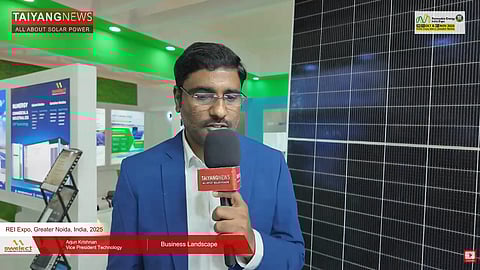
During the Renewable Energy India Expo (REI) 2025, the TaiyangNews team had the opportunity for a one-on-one interview with Arjun Krishnan, Vice President of Technology at SWELECT Energy Systems Limited (formerly Numeric Power Systems Ltd). He outlined the latest showcases, including solar-plus-storage systems and a PV module, and summarized the company’s future roadmap.
The company’s latest NUMERGY hybrid inverters and PYLONTECH series lithium-iron-phosphate (LFP) battery packs, developed for residential and commercial & industrial (C&I) prosumers, were displayed at the event. According to Krishnan, residential inverters have an AC power output range of 1 kW to 10 kW, while the C&I variants offer a higher, wider range of 15 kW to 100 kW. These inverters can be paired with multiple 5.12 kWh battery packs (as needed by the prosumers), each equipped with 100 Ah cells, to maximize solar harvesting by storing excess solar energy, typically during the summer or periods of low captive consumption. For instance, the showcased 10000T series hybrid inverter, with 2 MPPT channels, supports a 50 A DC input (2 × 25 A) from the connected PV array. In addition, its battery port is designed to connect 2 battery packs (2 × 5.12 kWh or 10.24 kWh) and can draw or discharge up to 50 A (DC) at a nominal charging/discharging rate. This inverter is rated to deliver a power output (AC) of up to 11 kW in either grid-tied or back-up (off-grid) mode. However, the company didn’t disclose the maximum rated backup duration.
After shifting to the displayed module, Krishnan says it comprises 132 G12R half-cut cells and is rated for a maximum power output of 630 W. These cells feature a 16BB metallization layout. But the module efficiency and size were not given. This module comprises non-DCR cells and is being produced commercially at the company’s Coimbatore factory, with an annual production capacity of 1 GW. Given the rising demand for PV modules, driven primarily by utility battery energy storage systems (BESSs), which support up to 180% DC/AC oversizing compared to 125% for on-grid systems, the company aims to expand its capacity to 2 GW. Krishnan explains that, due to the non-availability of G12R-size domestic cells, the company uses non-DCR cells. He adds that the upcoming approved list of models and manufacturer list II (ALMM II), and the approved list of cell manufacturers (ALCM) (expected to be available by April 2026) will feature M10R size cells in the majority.
The company also produces module mounting structures (MMS) at its Edappadi, Tamil Nadu factory with an annual production capacity of up to 500 MW. However, the company plans to expand it further to 1 GW. Krishnan says that SWELECT’s 2 factories consume up to 90% of captive power from solar energy, in line with its sustainability ambitions. Moreover, the company offers engineering, procurement, and construction (EPC) services to 3rd-party solar developers, while it is an independent power producer (IPP).

