

BC is gaining wider attention in the global solar PV industry as manufacturers improve processes and narrow cost gaps with TOPCon, according to industry leaders and experts on Day 1 of TaiyangNews' annual flagship event
Experts project strong growth for this technology as efficiencies rise and market adoption improves
Supply chain and cost barriers do exist in some regions as of now; adoption by the Chinese will accelerate its global presence
The 2025 edition of the TaiyangNews High-Efficiency Solar Technologies Conference, the annual flagship event of TaiyangNews, officially kicked off on December 3, bringing together leading manufacturers, equipment suppliers, and R&D experts from across the globe.
Spread across 4 days (December 3-4 and 9-10), the conference is designed to spotlight 3 major technology tracks: TOPCon, Heterojunction (HJT), and Back Contact (BC)/Tunnel Back Contact (TBC) – tackling not just cell performance, but module design, manufacturing efficiency, and cost-structures too, especially in times of huge production capacities and rising production costs.
Day 1 of the event was devoted to BC technology. TaiyangNews Head of Technology Shravan Chunduri outlined new insights from the TaiyangNews TOP SOLAR MODULES Listing. The efficiency charts are dominated by BC technology. AIKO holds the top position, having increased its module efficiency from 22.8% in 2023 to 24.4% by June 2025 – a 1.6% jump. While BC remains the clear leader on the list, the number of BC manufacturers is still limited to 4, though this is expected to expand as adoption grows, he added.
In his keynote address, the Co-Founder and Director of ISC Konstanz, Dr. Radovan Kopecek, discussed the prospects of BC in a fast-moving global electricity market. As solar is forecast to become the dominant global power source, driven by falling costs and evolving technologies, especially PV combined with battery storage addressing concerns about intermittency, the future is bright for the industry.
Kopecek shared projections that see the solar market reaching 1 TW in 2027, followed by an average annual growth rate of about 25%. While PERC enabled the industry’s expansion and TOPCon is currently leading, he believes n-type BC technology is emerging as the final, dominant PV architecture, driven by its ability to push module efficiencies to 25-26%+, a near 80% bifaciality, and a potential of <1 ct/kWh LCOE. He explained that a few regions still relied on PERC, particularly the US, due to strong TOPCon patents, while India is moving toward TOPCon and beginning to explore BC upgrades.
According to ITRPV, BC was gaining momentum, and ISC expected its market share to grow quickly – potentially reaching up to 40%. Kopecek stressed that China’s decisions would heavily shape the pace of this transition; if it shifted to BC production, global adoption would accelerate. He also observed that Chinese manufacturers were not building many new factories but were increasing output through higher-efficiency technologies, which could see BC playing an important part in the next growth phase.
Speaking about BC technology innovations, LONGi’s Product Marketing Manager, Dante Zeng, explained how BC technology advanced through structural improvements and higher efficiency. He said LONGi uses a 4-layer protection system in its BC modules to enhance crack resistance, supported by features such as TaiRay wafers, thicker wafers, one-line welding, and a high-quality adhesive film.
Zeng sees a bright future for BC as the current BC cell efficiency is about 27%, ahead of other technologies, and the gap is expected to widen with technological innovations. While there is still a 1% gap to the theoretical limit, he expects BC cells to reach around 28.5% in the next 3-5 years and modules to exceed 26%.
To accelerate progress for this technology, he pointed to better light management, hybrid passivation, advanced metallization, multi-slicing, high-density encapsulation, and smarter soldering and module processes.
AIKO’s Senior Product Solution Manager, Guillermo Estébanez, introduced the company’s All Back Contact modules, touting their higher power, higher returns, and ultra-reliability features.
The company's product portfolio covers residential, utility-scale, and C&I uses, and offers outputs from 480-490 W to 770-805 W. He said they provide about 30 W more yield than standard panels.
Estébanez added that the modules can deliver higher energy yield compared to conventional modules, reduce BOS costs by 1.1 cent/W, and lower LCOE by 5.77%.
According to AIKO, the modules now achieve over 80% bifaciality due to design improvements, including narrower fingers, thinner n-poly layers, smaller structures, and zero busbar (ZBB) interconnection. He also shared that the ABC modules now feature TÜV Rheinland-certified fire-resistant technology that promises better thermal safety and advanced hot-spot protection.
From an equipment supplier perspective, Leadmicro CTO Jerry Liao outlined the company’s recent advancements from TOPCon to TBC solar cell solutions. Citing third-party analysis of cell technologies that see both HJT and xBC competing neck-and-neck in terms of market share till at least 2027, Liao said his company is aligned with the market evolution. Starting in 2024, Leadmicro has made turnkey solutions available for TOPCon+/TBC and perovskite tandem technologies.
He highlighted 3 main process routes – LPCVD, hybrid LPCVD + PECVD, and the new PECVD route – alongside evolving TBC equipment options. Leadmicro’s TBC equipment includes ALD, which can increase capacity by around 50%, and an improved LPCVD process delivering about 40% gains. The new PECVD route offers roughly 20% higher capacity and better uniformity, supported by edge passivation and laser processing.
Liao added that TBC equipment investment intensity has dropped significantly, from roughly RMB 350 million/GW to about RMB 230 million/GW.
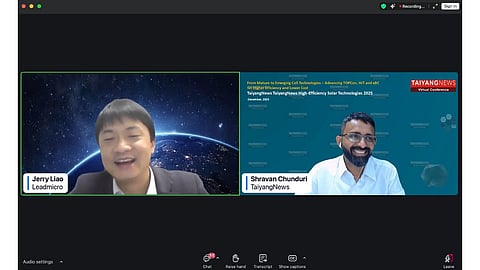
Leadmicro CTO Jerry Liao, in a fireside chat with TaiyangNews’ Shravan Chunduri, deliberated on the BC technology’s market growth as a mainstream technology. China, currently the world’s largest solar PV market, is devoted to TOPCon, which sets the pace for the rest of the world. India, he shared, shows interest in BC technology, but limited supply chain and skilled manpower remain barriers. Nevertheless, the interest exists, as Liao notes that most Indian companies currently inquire about upgrade options or pilot BC lines rather than full-scale production.
Liao also shared that industry perception of BC has improved, and its market share is expected to grow, though more slowly than the transition from PERC to TOPCon. The cost gap between TOPCon and BC should narrow in the next couple of years, with equipment costs and silver consumption remaining major cost drivers. Silver-coated copper, he added, could help reduce metallization costs.
Upgrading from TOPCon to BC is technically feasible but economically case-specific, as equipment continues to evolve. He said BC is ready for mass production thanks to progress by LONGi and AIKO.
For manufacturers considering BC, Liao advised starting with TOPCon and moving to BC through a pilot line. He said China, with its mature ecosystem, can scale BC more easily, but broader adoption will depend on penetrating the large utility-scale market.
TaiyangNews continues with the remaining 2 days of the 4-day High Efficiency Solar Technologies 2025 Conference. After devoting a day to TOPCon on December 4, TOPCon will once again be the subject of discussion on December 9, followed by HJT on December 10. Registrations are free and open for both days here.
