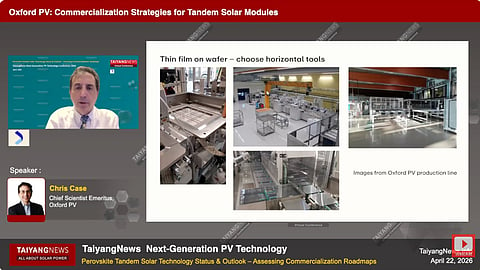


Chris Case traced the evolution of tandem commercialization from early perovskite research to Oxford PV’s commercial module launch and patent licensing activities
He said perovskite-silicon tandem structures currently offer the strongest pathway for large-area, utility-scale deployment due to their high efficiency retention at larger device sizes
Case emphasized that tandem technologies must integrate into existing silicon manufacturing infrastructure and eventually compete on delivered energy rather than only module price-per-watt
As the PV industry looks for ways to push the efficiency limits of conventional crystalline silicon solar cells, there is growing commercial interest in tandem solar technologies. Beyond cell efficiencies, the industry is also evaluating how tandem technologies can be integrated into existing manufacturing lines, qualified for long-term reliability, and commercialized at scale.
Speaking at the TaiyangNews Virtual Conference on Next-Generation PV Technology, Oxford PV’s Chris Case discussed the commercialization pathway for perovskite-silicon tandem solar modules. He combined perspectives from more than 4 decades in the PV industry with insights from Oxford PV’s tandem development activities.
Focusing on the role of geopolitics in shaping the PV industry’s growth trajectory, Case cited events such as the oil embargo, Germany’s feed-in tariff policy, COVID-related supply chain disruptions, and the Russia-Ukraine conflict as examples that renewed focus on energy security and domestic manufacturing. He also referred to policy initiatives such as the US Inflation Reduction Act and Europe’s Net Zero Industry Act (NZIA), noting that PV remains competitive despite policy uncertainty and implementation delays. Case further highlighted that rising electricity demand linked to AI and data centers will require substantial additional renewable generation capacity in the coming years.
Perovskite technologies have been in focus since around 2014, though commercialization timelines have extended over nearly a decade. According to Case, perovskite-silicon tandem structures continue to stand out among tandem architectures due to their combination of high efficiency and stable performance at larger device sizes. This combination appears to be the most commercially viable route for terrestrial and utility-scale deployment. Oxford PV adopted the tandem-on-silicon approach to minimize disruption to the existing silicon value chain. The approach was designed to integrate with established manufacturing lines rather than requiring manufacturers to replace existing silicon infrastructure. Large-area device scaling was also described as essential for identifying commercialization challenges early in development.
Given its high voltage and simpler integration pathway, heterojunction (HJT) initially emerged as the preferred bottom-cell technology for tandem structures. At the same time, TOPCon technologies have advanced significantly over the past decade, reaching voltage levels previously thought unattainable. Despite these improvements in TOPCon, HJT remains a strong candidate for tandem bottom-cell applications.
Case’s presentation also discussed manufacturing considerations for tandem module production. He described module assembly as remaining as close as possible to conventional glass-glass module manufacturing, with most of the innovation concentrated at the solar cell level rather than in the module structure itself. For HJT-tandem cells, Case presented low-temperature interconnection approaches such as electrically conductive adhesives as preferable alternatives to conventional soldering techniques. Equipment configuration was another focus area. Future tandem production lines were described as better suited to horizontal deposition platforms, which simplify automation and reduce handling challenges associated with sensitive cell surfaces.
Reliability remains one of the major challenges to commercialization for tandem technologies. Accelerated stress testing is essential because manufacturers cannot wait decades to validate long-term field performance. Case emphasized that tandem degradation must be studied from the molecular level through to full-device behavior, supported by analytical tools and climate-based degradation models. Existing PV qualification standards for perovskite technologies are also still evolving, since many current standards were originally adapted from technologies such as CIGS and cadmium telluride. Case also noted that tandem devices should be stressed under maximum power point (MPP) operation, illumination, and elevated temperatures to better identify degradation pathways.
The growing importance of intellectual property in the PV industry was another focus area during the discussion. Case said the sector is entering a period of ‘solar patent wars’, with companies increasingly enforcing patent portfolios and licensing technologies.
As part of this trend, Oxford PV announced a patent licensing agreement with Trinasolar in 2025. The agreement covers patent rights rather than direct technology transfer and allows manufacturing and sublicensing activities within China. Case said such agreements help tandem manufacturers avoid the type of patent disputes currently affecting TOPCon technologies. He also mentioned that Oxford PV recently announced another non-exclusive licensing agreement with a US company.
Case noted that turnkey tandem manufacturing solutions are already available from multiple equipment suppliers in China, Korea, and other parts of Asia, while Western equipment ecosystems remain comparatively limited.
He acknowledged that the PV industry is currently facing severe overcapacity, with global manufacturing capacity exceeding annual installations. He, however, described this imbalance as temporary and said that long-term demand growth linked to electrification, AI infrastructure, and the global energy transition will eventually require multi-terawatt levels of annual PV deployment.
The industry also continues to rely heavily on price-per-Watt metrics. Case said PV products should instead be evaluated based on delivered energy and the levelized cost of energy (LCOE), particularly for tandem technologies, which are inherently more complex and expensive to manufacture than single-junction silicon devices.
Chris Case’s full presentation, titled ‘Commercialization Strategies for Tandem Solar Modules’, can be accessed here.
