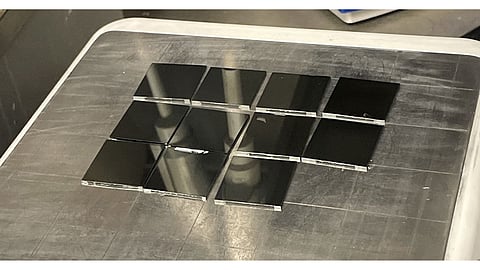


Researchers from UC San Diego developed a method that forms a temporary liquid during perovskite crystallization to reduce defects
Solar cells reached 26.5% efficiency, with a certified value of 25.9%, while mini-modules larger than 15 cm² achieved 23.9%
According to the university, the solar cells retained most of their initial efficiency after 8 weeks of continuous operation under simulated sunlight
Researchers at the University of California San Diego (UC San Diego) have developed a perovskite crystallization method that uses a temporary liquid to produce larger, more uniform crystals with fewer defects. Solar cells made using the method achieved 26.5% power conversion efficiency, with a certified result of 25.9%. Perovskite mini-modules with areas larger than 15 cm² reached 23.9% efficiency.
Prof. David Fenning led the UC San Diego group, working with researchers at Princeton University in the US and Sungkyunkwan University in South Korea.
Perovskite films can be made by depositing a solution onto a surface. While this could simplify production, the resulting layer contains many small crystals. Defects at their boundaries can cause electrical charges to recombine before the cell collects them, reducing output.
To reduce defects at the crystal boundaries, the researchers added zinc bromide and methylammonium chloride. During heating, the two salts formed a eutectic mixture, which melts at a low temperature. This temporary liquid helped the growing crystals rearrange into a more ordered structure. As heating continued, methylammonium chloride evaporated, while zinc remained near the crystal boundaries and helped reduce electronic defects.
“We introduce a new way of tuning the growth of halide perovskites by developing an additive mixture that actively evolves during crystallization,” said study co-first author Connor Dolan, a chemical and nano engineering PhD alumnus from UC San Diego.
X-ray measurements showed that material near the crystal boundaries became disordered and liquid-like during heating. It regained its ordered structure as the salt evaporated and crystal growth ended, without a change in temperature.
The treatment produced larger, better-ordered crystals with fewer structural defects. The film also showed more consistent chemical properties. Measurements showed longer-lived electron-hole pairs, indicating reduced recombination losses.
According to UC San Diego, the solar cells retained most of their initial efficiency after 8 weeks of continuous operation under simulated sunlight.
The approach worked across the different perovskite compositions tested. The researchers are now exploring other eutectic mixtures to better understand and control crystallization.
The study, titled Volatile eutectics to tailor crystallization for perovskite optoelectronics, received support from the US Department of Energy, the US National Science Foundation, Princeton University startup funds, the National Research Foundation of Korea, and the Korea Research Institute of Chemical Technology.
