
Key takeaways:
Tigo Energy’s GO Optimized ESS extends its MLPE offerings into the residential energy ecosystem
The platform combines module optimizers, battery storage, inverters, and home energy management
The Energy Intelligence platform enables monitoring and battery operation based on user preferences and electricity tariffs
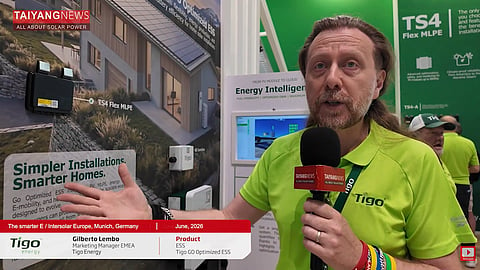
US-based Tigo Energy showcased its GO Optimized Energy Storage System (ESS) for the European residential market at Intersolar Europe 2026.
The rooftop module-level power electronics (MLPE) solution provider, founded in 2007, has now expanded its offerings to include several other components required for an integrated ESS. MLPE refers to an electronic device installed at the individual PV module level, enabling each module to operate independently and improving energy production under shading and module mismatch conditions. Additionally, it provides module-level monitoring for an installed PV system.
The showcased ESS combines the company’s MLPE with residential storage and energy management. The TS4-A-O optimizer, the company’s module-level component mounted behind each PV module, supports modules up to 725 W.
To manage the electricity generated on rooftops, Tigo offers its GO Optimized Inverter and EI Link, with the latter serving as a central connection hub for the system, linking the inverter, battery, and household loads. It physically connects to the inverter, communicates with optimizers, and enables commissioning, monitoring, over-the-air updates, et cetera.
The company also presented its GO Battery for storing surplus generated energy. The battery uses stackable lithium iron phosphate (LFP) modules. Each module provides 3.68 kWh of storage and can be expanded to 47.9 kWh. The battery pack comes with an IP65-rated enclosure and an inbuilt heating function; the batteries can even be operated at -30°C, says Tigo.
Beyond solar and storage, the company also presented other household assets, such as the GO EV Charger and the GO Junction. The latter is used to provide an interface for integrating heat pumps and other household electrical loads.
EI Link, which serves as a hub connecting all of these, is powered by Tigo’s Energy Intelligence (EI) platform. Through this application, installers can commission, monitor, and diagnose multiple installations, and homeowners can monitor energy generation, battery status, and electricity consumption. Tigo also introduced dynamic electricity tariff management in selected EU markets, such as Germany, the Netherlands, and the UK, to optimize the battery’s charging and discharging based on electricity prices.

