

Tongwei’s new system-level solution increases DC-side PV capacity to twice or several times its original level while integrating energy storage
The company claims the solution can increase annual power generation hours to 3,000 to 4,000 hours per project
It has selected several pilot projects, mostly involving the retrofitting of existing PV power plants
Chinese solar manufacturer Tongwei has launched its High-Capacity-Credit PV System-Level Solution at the 9th International Photovoltaic and Energy Storage Industry Conference 2026 (PESIC). The solution combines solar PV and energy storage to deliver more stable, controllable power to the grid.
Tongwei says the concept is based on what China’s power sector calls ‘dependable power output’. The metric assesses a power plant’s ability to reliably supply electricity during critical periods of grid demand, rather than its overall energy generation.
China’s 15th Five-Year Plan for Renewable Energy Development measures dependable power output as a share of installed generation capacity. According to Tongwei, the calculation considers the power available during critical supply periods at a 95% confidence level, with energy storage also contributing to this output. China has set average dependable power output targets of 6% for solar PV and 11% for wind by 2030.
The company also sees the solution as a way to address the supply-demand imbalance in China’s PV industry. With the domestic market facing declining installations, solar curtailment, and intense competition, it believes the approach could create additional demand for solar modules and energy storage systems (ESS).
Tongwei’s approach involves increasing a power plant’s DC-side installed PV capacity to twice or several times its original level while retaining the existing grid connection point. The ESS is sized based on the surplus PV generation. Excess electricity generated during the day can thus be stored and supplied to the grid during evening peak demand periods.
Hanyuan Liu, Chairman of Tongwei Group, said the approach can increase annual power generation hours to between 3,000 and 4,000 hours per project, bringing them closer to those of conventional thermal power plants. The company also expects the solution to improve equipment utilization and system efficiency.
The solution can be implemented in both existing and new PV power plants. Tongwei lists agrivoltaics, livestock farming, fishery-integrated PV projects, solar installations in desert regions, and commercial and industrial (C&I) parks among the potential applications. The company says its measured data indicate that, under suitable conditions, retrofitting existing projects with the solution can increase their overall rate of return by more than three percentage points. It sees further scope for improving returns in new projects with higher levels of PV oversizing.
Over the past six months, Tongwei has selected several projects to test the solution, most of which involve retrofitting existing PV power plants. At the November 18 launch, the company said it expected to connect these pilot projects to the grid by the end of the month.
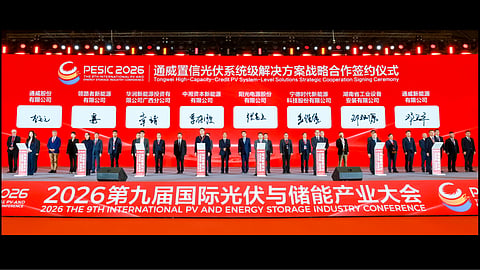
As part of the launch, Tongwei signed strategic cooperation agreements with six companies, including CATL, Sungrow, and China Resources New Energy. The cooperation covers energy storage batteries, inverter control, investment, financing and power engineering. The partners will work together on the design, construction, operation, and asset securitization of high-capacity-credit PV systems.
Tongwei also displayed two bifacial TOPCon modules from its TNC 3.0 series for C&I rooftop and utility-scale applications. The larger module, measuring 2,384 × 1,303 mm, has a maximum power output of 770 W, while the smaller format, measuring 2,382 × 1,134 mm, offers up to 670 W. Both feature an efficiency of 24.8%, a quarter-cut cell configuration, a bifaciality of 85±5% and a power temperature coefficient of -0.26%/°C. The dual-glass modules use 2 mm glass on either side and come with a 12-year product warranty and a 30-year performance warranty (see Tongwei’s TOPCon Modules With 1/4-Cut Cell Architecture).
Also on display was the company’s laboratory-level THC heterojunction (HJT) module, with a maximum power output of 802.43 W and an efficiency of 25.83%. Previously presented at SNEC 2026, the high-power module measures 2,384 × 1,303 mm and incorporates 198 one-third-cut G12 cells. It features fine copper gridlines and zero-busbar (0BB) copper ribbon interconnection technology (see Tongwei’s 25.83% Efficiency HJT Module).