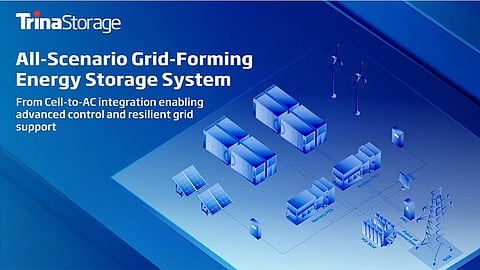

Trina Storage’s grid-forming technology offers grid ancillary services, including frequency response, voltage support, providing synthetic inertia, and black-start
Its grid-following mode also provides short-term overload and helps in coordinating with grid operations
The company’s grid-forming technology lab has an EMS testing platform, environmental stress chambers, RTDS simulation software, and a 35 kV voltage level testbed
With a focus on stability and flexibility of the green transmission grid, Trina Storage, the energy storage business unit of TrinaSolar, recently launched its All-Scenario Grid-Forming Energy Storage System at the Energy Storage Industry Innovation Alliance Summit.
According to the company, the unique selling proposition of the product is grid support capabilities (ancillary services), covering all scenarios that are well-known to grid operators. It combines a flexible DC battery cabinet, an integrated medium-voltage switchgear unit, and an energy management system on a skid-based platform. Unlike the standard battery energy storage systems (BESS) based on grid-following technology, which act as a source of current to synchronize with a regional grid voltage and frequency, its grid-forming function enables it to act as a voltage source. This helps form frequency and voltage at the individual plant level, rather than following the regional grid. Without any rotational mass-based inertia support, typically common in thermal power plant-based grids, it enables fast switching for power electronics components. This attribute provides synthetic inertia that injects – or absorbs – active power to the grid in proportion to the rate of change of grid frequency and stabilizes an unstable grid. This storage system also injects or absorbs reactive power during undervoltage and overvoltage grid conditions, respectively, by leveraging its voltage source function. In addition, it ensures stable operation in weak grids with a low short-circuit ratio (SCR), without failures or shutdowns. SCR is the ratio of the grid’s short-circuit capacity at the connection point to the inverter or plant’s rated power; however, the company’s press release didn’t disclose the allowable range of SCR. Following a regional power grid blackout, grid operators look for self-starting power sources (hydropower, battery storage, etc.) to resynchronize and stabilize the grid or black-start, which this grid-forming BESS can help achieve in under 3 minutes.
Regarding its grid-following capabilities, the company states that its latest BESS supports up to 150% overload (discharging) during sudden spikes in energy demand or the start-up of large industrial motors, among others. While Trina Storage didn’t share the maximum overload duration, it actively participates in continuous coordination with power grid controllers for automatic generation control and automatic voltage control (AGC/AVC) in real time.
In terms of research & development (R&D) capabilities, Trina Storage possesses a digital simulation and validation platform for grid-forming technologies. These are supported by an EMS testing platform, environmental stress chambers, and a 35 kV voltage level testbed. This in-house lab also features RTDS to simulate and analyze the BESS’s grid-interactive behaviors for potential scenarios.
Apart from utility grid-scale-based grid-forming capabilities, the company says this BESS is designed for multiple application scenarios, including hybrid RE generation, microgrids, and AI data centers (AIDC).
The company cites the case study of a 233 MW/932 MWh project in partnership with Atlas, a Chile-based project developer, where the grid-forming controls will be deployed. In Australia, the company completed PSS/E and PSCAD simulation of a 250 MW/500 MWh project with grid-forming capability, which later received AEMO GPS 5.3.4 certification.
Head of the Advanced Power Electronics Institute, Mr. Yu Hong, summed up by saying, “As power systems integrate more renewables, the industry needs storage solutions that do more than follow the grid—they must help shape it.” He continued, “Our grid-forming solution is designed to strengthen system resilience under diverse grid conditions and support the next stage of global energy transformation.”

