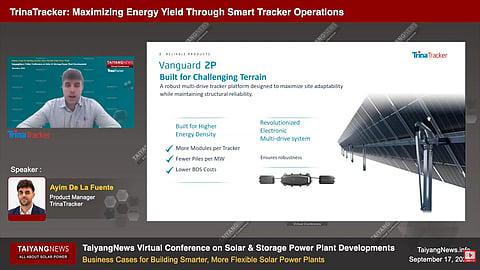

TrinaTracker presented its fixed module mounting structure, FixOrigin, and Vanguard 1P and 2P tracker systems at the conference
The presentation also included a brief discussion of its SuperTrack intelligent tracking optimization software
On the robotic solutions side, the company presented its Buildex-D robot for module installation and Aurora for module cleaning
Today, utility PV plant owners and developers are looking beyond simply delivering cheap electricity to the grid because of increased pressure to improve project profitability, maximize energy yields, and optimize operations and maintenance (O&M).
Ayim De La Fuente, Product Manager at TrinaTracker, presented the company's latest product portfolio at the TaiyangNews Solar Power Plants & Storage Conference 2026, aiming to help ‘customers get more value from solar plants’.
De La Fuente began with the company's fixed module mounting structure, FixOrigin, available in two variants: Monopost and Bipost. Both can adapt to undulating terrain with up to 30% north-south and 20% east-west slopes. The company validated the maximum dynamic mechanical load limits for these products through wind tunnel tests, ensuring they are ready for long-term field operations.
He then moved to the Vanguard 1P tracker platform, which offers three configurations: single, dual, and multi-drive. The company targets the single-drive tracker for standard site conditions, while its dual-drive peers suit projects that require more stability and longer tracker length. For extreme site conditions, which demand more structural support and control, the company prefers its multi-drive trackers. In addition to hardware, this platform includes Vanguard 1P Terrain+ features with embedded proprietary software, TTOPO. Its algorithm helps the tracker follow the land’s natural contour with a maximum slope difference of 1.5° between piles and mounting structures. This alignment reduces grading, civil, and site preparation work, optimizing costs without significantly disturbing the land contour.
TrinaTracker's Vanguard 2P tracker was also a highlight of De La Fuente's presentation. Built to mount modules in a 2-in-Portrait (2P) configuration, it delivers higher energy density with fewer piles per MW than 1P alternatives, he said. The tracker features an electronic multi-drive system that synchronizes multiple drives with fewer mechanical transmission components than traditional mechanically linked counterparts. He emphasized this feature as a key differentiator from competitors.
The company offers its SuperTrack intelligent tracking optimization software with two algorithms – Smart Tracking Algorithm (STA) and Smart Backtracking Algorithm (SBA). STA helps maximize energy capture by adjusting trackers based on site conditions and real-time irradiance. The SBA reduces row-to-row shading during the morning and late afternoon by automatically adjusting backtracking operations. According to TrinaTracker, together these features can boost energy generation by up to 8% compared to conventional tracker-based alternatives.

The presentation also included an installation and PV-cleaning robot to show how robotics can support construction and optimize O&M. The installation robot, Buildex-D, uses an autonomous vehicle to transport module packages across the site. It then scans individual modules and the structure to pick them up and place them in the correct positions. This robotic workflow eliminates repetitive manual module handling, enables easy installation of large and heavy modules, and reduces microcracks. He cited field performance data, showing a module breakage rate of just 0.026% across 300 MW of deployed projects.
The company's Aurora PV module cleaning robot, compatible with both tracker and fixed-tilt structures, automatically cleans these mounted PV modules using intelligent navigation and protection functions. A local remote monitoring system can automatically monitor these robots' real-time position, operation status, and alarms. TrinaTracker's self-developed cloud management system also enables coordination between multiple cleaning robots and provides real-time operational status. According to De La Fuente, the company has deployed more than 350 robots across different countries.
On the services side, the tracker maker offers TrackGuard full lifecycle services.
