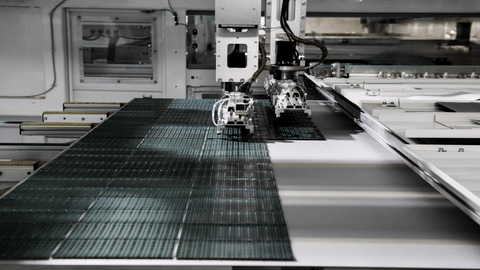

Key takeaways:
Trinasolar and LONGi have reported BC cell efficiencies of 28% and 28.13%, respectively, using hybrid passivation approaches
Hybrid BC designs combine TOPCon and HJT passivation, enabling higher efficiencies while leveraging existing manufacturing routes
The results indicate a broader shift toward BC technologies among major Chinese manufacturers
Mainstream solar cell technologies are rapidly approaching their theoretical efficiency limits, whether it be TOPCon, heterojunction (HJT), or back-contact (BC). However, some companies are finding innovative ways to improve efficiencies, with 2 well-known names in the PV industry recently announcing record cell efficiencies for silicon-based solar cells.
First, it was Trinasolar, which revealed a high-efficiency BC cell with 28% in the last week of April 2026. LONGi followed up the next day, reporting an even higher-efficiency BC cell of 28.13%.
Both of these cells use hybrid passivation on the rear side of the cell, which Trinasolar calls THBC (TOPCon-compatible hybrid back-contact) and LONGi calls HIBC (hybrid interdigitated back contact). In this context, ‘hybrid’ implies passivating one polarity with TOPCon and the other with HJT. According to recent research studies and a paper published by LONGi in November 2025, the n-polarity is TOPCon-passivated, and the p-polarity is HJT-passivated. One can assume that Trinasolar also follows a similar approach.
Trinasolar achieved the 28% efficiency on a 210R wafer, a size it uses for its other commercially available modules, whereas LONGi achieved the 28.13% on an M10 wafer. Both efficiencies were independently confirmed by Germany’s Institute for Solar Energy Research Hamelin (ISFH).
LONGi has been making modules with HIBC cells, and these are commercially available products with roughly 1 GW of production capacity. TaiyangNews’ TOP SOLAR MODULES has been featuring this module since December 2025. LONGi mentioned that the HIBC modules with an efficiency of 26.4% were certified by the US National Laboratory of the Rockies (NLR, previously NREL). However, the TOP SOLAR MODULES features LONGi’s HIBC commercial module with 25% efficiency and a power output of 510 W. The module measures 1,800 x 1,134 mm, a size that is suitable mainly for residential applications.
With the latest announcement, Trinasolar entered the BC race a little later than other major players like LONGi and AIKO. However, its achievement of record cell efficiency, which holds the second position now among cells, shows a real shift towards BC among tier-1 Chinese manufacturers. It is particularly interesting that the recent TaiyangNews flagship event, High-Efficiency Solar Technologies Conference 2025, Trinasolar presented a technology roadmap devoid of BC (full presentation here).
The company positions its THBC technology as TOPCon-compatible, implying that mainstream production lines may require only upgrades rather than complete replacement or new builds. According to Trina, the cell can be made on wafers as thin as 110 µm. It has a pilot line dedicated to this technology, and modules measuring 2,382 x 1,134 mm – with a maximum power output of 700 W – can be made using THBC cells. Other technical product details or further plans by Trinasolar are unknown at the time of writing this article.

