
Key takeaways:
Trinasolar described how regulatory frameworks and market expectations are increasing the need for transparent, verifiable carbon-footprint data across the PV value chain
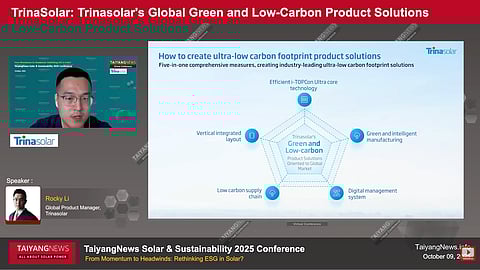
The company outlined measures such as higher-efficiency cells, green-powered factories, vertical integration, and supplier audits as contributors to reduced embodied carbon
Traceability and digital carbon-management platforms are emerging as central tools for meeting certification requirements and supporting life-cycle assessment
At the TaiyangNews Solar & Sustainability Conference, Rocky Li, Global Product Manager at Trinasolar, presented the company’s approach to low-carbon manufacturing and product-level sustainability. Governments worldwide have introduced policies such as the Paris Agreement, the European Green Deal, China’s dual-carbon goals, and expanding carbon-pricing mechanisms, which now cover roughly a quarter of global emissions. Li emphasized that carbon cost is increasingly becoming an economic factor, influencing competitiveness and even market access. As a result, solar products must now meet strict carbon-footprint requirements across markets, from EPD requirements in Italy, Sweden, Norway, and Austria to France’s Certisolis carbon-footprint certification, and China’s new low-carbon evaluation framework for exported modules. Growing expectations from developers, financiers, and procurement programs further reinforce the need for standardized carbon-footprint transparency, he said.
Li explained that Trina’s ESG framework includes environmental initiatives such as zero-carbon and zero-waste factories, research collaborations, governance measures, and measurable corporate goals, such as reducing energy use per megawatt by 40% and greenhouse-gas intensity by 50% by 2025, and reaching 100% renewable energy use across global operations by 2030. Within this framework, Trina reports having produced modules under ISO 14067 standards for low carbon footprint and multiple regional EPDs that have achieved a 300 kg-CO₂/kW level – around 20% below the industry average. The company also reports low-carbon certifications for its tracker and mounting systems.
Li attributed these certifications and carbon-footprint reductions to Trinasolar’s system of technological and manufacturing measures. The first element is improving cell efficiency, which increases module power by 20-30 W while reducing carbon footprint per watt through higher output. The second is the company’s factory model, with automated production sites that use green electricity, waste-reduction measures, AI-enabled inspection, and real-time transparency tools. Trinasolar reported achieving several industry firsts, including third-party-verified zero-carbon and zero-waste certifications. The next element is vertical integration across ingots, wafers, cells, and modules, exemplified by the company’s Qinghai operations, which benefit from the region’s more than 94% clean-energy share, significantly lowering embodied emissions. Another is low-carbon supply-chain management, including audits and ESG requirements for suppliers of materials such as glass, coatings, frames, and junction boxes. He added that a similar set of manufacturing and supply-chain measures is implemented for trackers and mounting structures, supported by third-party audits (e.g., BV, TÜV) and overseas manufacturing bases that reduce transport-related emissions.
Li also emphasized traceability as an emerging requirement aligned with carbon-management demands. Trina reports having achieved full AA-level traceability certification across the entire value chain – from polysilicon to module – and stated that over 10 GW of orders have already complied with traceability verification. To support data transparency, the company says it has developed a digital carbon management system that links product information, carbon footprint data, ecological indicators, and certifications through a single QR code. A cloud-based carbon footprint platform, audited by a third party, enables life-cycle assessment, EPD modeling, reporting, and continuous improvement through standardized workflows.
In conclusion, Li summarized that Trinasolar aims to offer globally deployable low-carbon product solutions supported by efficiency-enhanced cell technology, intelligent manufacturing, vertically integrated production, and digitalized supply-chain management. These measures, he argued, support customers in meeting market-access requirements, improving financing prospects, and addressing sustainability expectations across the PV value chain.

