

Trinasolar’s TOPCon roadmap has reached the Ultra stage, with mass production module efficiencies above 24% and a pathway toward 30% cell efficiency
The company reported higher theoretical bifaciality and lower leakage current for TOPCon compared to BC
Two 3.6 MW case studies in Germany and Spain showed BOS reduction, improved LCOE, and higher revenue during peak price periods, highlighting the system-level impact of TOPCon in tracker projects
As module competition increasingly shifts from nameplate efficiency toward system-level energy yield, manufacturers are refining established n-type architectures rather than introducing entirely new platforms.
At the TaiyangNews High Efficiency Solar Technologies Conference 2025, Ling Zhuang, Product Manager at Trinasolar, presented the company’s TOPCon roadmap under the theme of boosting energy yield to the next level. The presentation focused on structural and system-level factors influencing real-world power generation, including bifaciality, low-irradiance behavior, shading response, and project economics. The company refers to this roadmap as its ‘i-TOPCon’ development path.
Trina’s journey with TOPCon began with i-TOPCon Plus in 2020 and progressed through i-TOPCon Advanced to the current i-TOPCon Ultra stage. The earlier phase incorporated both 210 mm wafers and rectangular wafer formats across medium- and small-format modules, reaching laboratory cell efficiencies of 26%. The company noted that its TOPCon cell efficiency record reached 25.43% in July 2023, certified by ISFH, while module efficiency exceeded 24% in mass production. The current Ultra phase focuses on production scale-up and metallization refinements, including narrower screen-printed grid lines below 15 µm to reduce shading losses and optical parasitic absorption. Over the next 5 years, Trinasolar aims to further push cell efficiency towards 30%, says Zhuang. Looking further ahead, the roadmap includes TOPCon-perovskite tandem integration targeting cell efficiency above 30% and module efficiency beyond 28%.
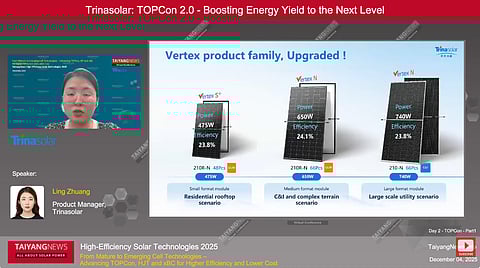
The company also presented a full upgrade of its Vertex product family. The upgraded portfolio includes small-format 475 W module reaching 23.8% efficiency, targeting residential rooftop applications. The company offers a 650 W module with an efficiency of 24.1% efficiency for C&I and complex terrain projects. A high-power module rated at 740 W and 23.8% efficiency is designed for utility-scale installations.
Zhuang presented a comparison of TOPCon and Back Contact (BC) architectures from a structural perspective. Based on its analysis, the company estimates a theoretical bifaciality of approximately 85% for TOPCon versus around 70% for BC. The calculation accounted for front cover losses, back polishing impact, back cover losses, and polysilicon parasitic absorption affecting both the front and rear sides. In an empirical comparison, rear-side gain measured at 5 p.m. was 8.14% for TOPCon and 6.44% for BC, corresponding to a 1.7% advantage. Zhuang clarified that this figure represents rear-side contribution rather than overall module performance.
Low-irradiance behavior was discussed from a structural standpoint. In TOPCon cells, the P and N regions are located on opposite sides, whereas both are placed on the rear side in BC cells. According to Trinasolar’s data, BC cells may contain up to 200 leakage current channels per cell. Under bias-testing conditions, leakage current was measured at 0.05 for TOPCon and 2.05 for BC, indicating significantly higher leakage in the latter. Since higher leakage current reduces shunt resistance, this affects low-light performance. In field measurements under irradiance between 100-200 W/m², TOPCon modules reportedly achieved approximately 7% higher relative performance, equivalent to around 1% higher actual output. However, Zhuang noted that in markets such as Spain, China, and Australia, the dominant irradiance band is around 280 W/m², reducing the overall weight of low-light conditions in annual yield calculations.
Shading response in ground-mounted conditions was also examined. Short-edge shading, commonly caused by row spacing and structural layout, was analyzed using I-V and P-V curves. When shading affected less than 1% of the cell area, performance differences between TOPCon and BC were negligible. When shading exceeded 1-2%, the remaining power ratio stabilized at approximately 50% for both technologies. Outdoor testing under typical sunny conditions showed comparable behavior between the 2 architectures, even when shading extended to the height of 2 cells.
Trinasolar presented 2 case studies from 2 separate 3.6 MW projects to illustrate system-level implications under different system configurations. In a tracker-based project in Spain, the same module reduced BOS by 0.07 US cents/W and lowered LCOE by 2.68%, while increasing the internal rate of return (IRR) by 0.4%. In the Germany tracking scenario (Brandenburg), the company reported €239,000 in additional revenue per 100 MW of capacity due to higher generation during morning and late-afternoon high-price periods. In Spain (San Nicolas), additional earnings were estimated at €383,000 per 100 MW capacity. Power generation during high-price periods was reported to increase by up to 4.6% in the tracking configuration.
Watch the presentation titled ‘TOPCon 2.0 – Boosting Energy Yield to Next Level’ on the TaiyangNews YouTube Channel here.
