

ETFE frontsheets showed 1% to 2% higher soiling-related transmission losses than PV glass
Hydrophilic and matt ETFE surfaces showed lower soiling losses than their respective counterparts during the initial months of outdoor exposure
Rainfall restored the initial transmittance of artificially soiled glass samples, while ETFE retained losses of 0.5% to 1%
Researchers at Delft University of Technology (TU Delft) in the Netherlands studied the soiling behavior of ethylene tetrafluoroethylene (ETFE) frontsheets for flexible solar modules. Over a year of outdoor exposure, they recorded transmission losses on ETFE that were 1 to 2 percentage points higher than on PV glass.
Front glass accounts for nearly 70% of the weight of a conventional monofacial solar module. ETFE is a lightweight alternative to glass and, owing to its flexibility, can be used in solar modules for building façades, vehicles, and curved surfaces. Earlier studies on ETFE have looked at its optical properties and resistance to environmental stress. In the latest study, the TU Delft team looks at how these frontsheets respond to soiling.
The researchers studied four types of ETFE frontsheets – hydrophobic smooth, hydrophobic matt, hydrophilic smooth, and hydrophilic matt – along with PV glass without anti-reflective or anti-soiling coatings. Even before outdoor exposure, their optical performance differed. The weighted average transmittance ranged from 93.9% to 94.4% for ETFE and was 91.6% for glass.
Outdoor testing began in May 2024 at TU Delft’s PV monitoring station, where the samples were mounted at an 80° tilt. The transmission loss for glass exceeded 1% only in the last month of the study. Frequent rainfall and strong winds, along with the steep tilt angle, could account for the low losses.
Dust particles tend to adhere less strongly to hydrophobic surfaces because of their low surface energy. However, the hydrophilic ETFE samples showed lower transmission losses during the first eight months of outdoor exposure. The researchers link this observation to the frequent rainfall in Delft. Water spreads over hydrophilic surfaces, helping remove dirt. Matt surfaces also showed lower soiling losses than smooth surfaces during much of this period.
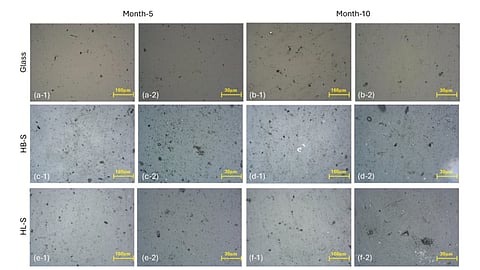
After 10 months, there was little difference in the soiling behavior of the four ETFE samples. The difference in surface wettability also decreased with outdoor exposure, as the initially hydrophobic samples became more hydrophilic. Their water contact angle, which was above 90° at the start of the study, decreased to 60°-70° after a year. Surface analysis points to several possible reasons for this change, including carbon deposits, photo-oxidation, and cross-linking.
An analysis of the contaminants revealed two types of particles. Silicon and metal oxide particles were generally smaller than 20 µm, while some amorphous carbon particles were larger than 100 µm. The researchers point to vehicle exhaust and nearby chimneys as possible sources of these carbon deposits.
Carbon-based particles occupied a much larger surface area than mineral dust. Optical measurements of the soiled samples showed decreased transmittance, with little change in reflectance. The loss was thus mainly due to the absorption of light by the contaminants and was more pronounced at shorter wavelengths.
To assess the effectiveness of rain in removing contaminants, the researchers deposited locally collected soil on the frontsheets in a separate experiment. This resulted in a transmission loss of 2% to 3% across all samples. After exposure to around 10 mm of rainfall, glass recovered its initial transmittance, whereas the ETFE samples still showed losses of 0.5% to 1%.
Rain easily washed away larger soil grains, while smaller particles remained on the surfaces. The researchers found that carbon-based contaminants were more difficult to remove from ETFE than from glass. This suggests that ETFE frontsheets may require additional cleaning even in regions with frequent rainfall.
The researchers published their findings in the journal Solar Energy in a paper titled Soiling behavior of flexible ethylene tetrafluoroethylene (ETFE) frontsheets deployed in outdoor environment for photovoltaic applications.
Some backsheet suppliers are also expanding their product portfolios to include polymer-based frontsheets as an alternative to front glass. These developments are discussed in the 6th edition of the TaiyangNews Market Survey on Encapsulation Materials & Backsheets 2026.