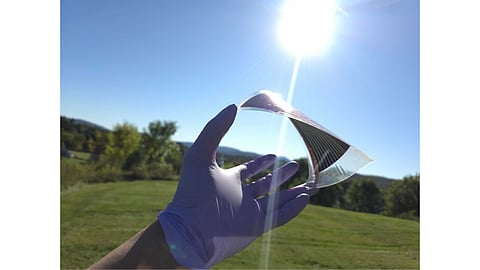


Verde Technologies plans to conduct its first in-space test of perovskite solar cells, with launch planned for June 2027 at the earliest
The company is prioritizing space and high-altitude applications for the commercialization of its perovskite technology
It says these flexible perovskite solar cells can be rolled or folded for launch and deployed into large arrays in orbit
US-based solar cell manufacturer Verde Technologies has signed a contract to test its ultra-thin perovskite solar cells aboard the International Space Station (ISS). The launch is planned for no earlier than June 2027, reports Payload, a media outlet covering the space industry.
As part of NASA’s Materials International Space Station Experiment (MISSE), Verde’s solar cells will be mounted on the exterior of the ISS for six months and later brought back to Earth for analysis. This will mark the company’s first attempt to validate its perovskite solar cell technology in space.
Verde Technologies was founded in 2021 as a spin-off from the University of Vermont, US. The company initially saw a market for its technology in commercial rooftops that could not support heavier solar modules, and in older solar farms that needed repowering.
Five years after its founding, Verde turned its attention to space and defense markets. The move came alongside the appointment of Jean-Noël Poirier as CEO in June 2026. Terrestrial applications, however, remain part of Verde’s long-term plans (see Verde Names Jean-Noël Poirier CEO To Scale Perovskite Solar).
On the manufacturing front, Verde has tested its technology on full-scale roll-to-roll equipment. It also reports a power conversion efficiency of over 24% using scalable manufacturing methods.
Growing demand from satellite manufacturers was one of the reasons behind Verde’s move into space applications. It expects the demand for solar cells to grow further with the development of orbital data centers and other energy-intensive space applications.
Verde identifies limitations in the existing solar cell options for space applications. While gallium arsenide solar cells offer good performance, their limited manufacturing capacity is a concern. Conventional silicon solar cells, on the other hand, face challenges related to weight and degradation in space.
As an alternative, Verde deposits perovskite material onto lightweight, flexible substrates rather than silicon or glass. This allows the solar cells to be rolled or folded during launch and subsequently deployed into large arrays in orbit.
Verde plans to work with partners to provide the necessary structural support for these arrays. By reducing the weight of solar arrays, it aims to lower overall spacecraft mission costs.
Solar technologies for space applications are also the focus of Day 3 of the TaiyangNews High-Efficiency Solar Technologies 2026 Online Conference, taking place today from 9:30 AM to 12:30 PM CET. Register for free here.