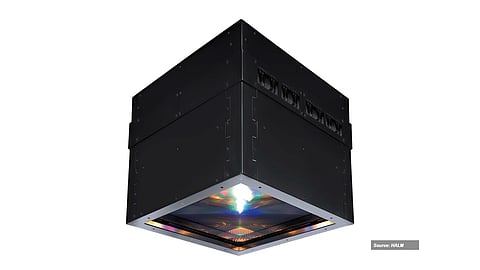


HALM offers both xenon- and LED-based IV testers, covering high-throughput production and laboratory applications
The cetisPV-IUCT-3600-BF remains the company’s mainstream production tool, supporting throughputs of up to 4,000 cells/hour
The LED-based cetisPV-IUCT-LF3.1 targets detailed cell analysis, enabling advanced diagnostics such as EQE, SunsVoc, and hysteresis measurements
HALM remains one of the established suppliers of IV testing equipment, offering solutions for both mass production and laboratory-based cell characterization. For the recent TaiyangNews Market Survey on Solar Cell Production Equipment 2025, the company has provided data for two IV testing platforms: the xenon-based cetisPV-IUCT-3600-BF, designed for mass-production environments, and the LED-based cetisPV-IUCT-LF3.1, which targets advanced laboratory characterization.
Introduced in 2018, cetisPV-IUCT-3600-BF remains the company’s main stream product for mass production. This xenon-based IV tester features a 240 × 240 mm illumination area, dual-source bifacial testing, and a wide range of features, including hysteresis analysis, SunsVoc, EL/IR imaging, and 2-diode modeling. The tester handles up to 4,000 cells/hour and integrates with various contact solutions for MBB and busbarless cells.The tool also supports IR imaging, EL imaging, grid resistance, and simultaneous measurement of 2 half-cut cells. The xenon lamp is guaranteed for 3 million flashes, although this extends up to 9 million flashes in practice.
cetisPV-IUCT-LF3.1, as mentioned above, is a lab tester based on LED light source with an A+A+A+rating. The LED light source, which combines 28 wavelengths, supports an adjustable spectrum. It has the same maximum illumination area of 240 x 240 mm. In addition to IV characterization, the tester is also designed to accomplish advanced hysteresis, SunsVoc, 2-diode analysis, doping concentration determination, MPP tracking, spectral response, and external quantum efficiency.
