

Colombia’s Ministry of Mines and Energy has launched a COP 103.7 billion funding call to support clean energy generation, sales, and its efficient use
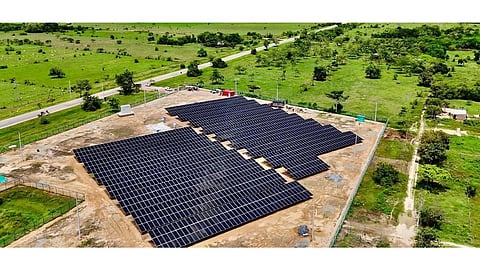
It will cover solar PV self-generation projects as well as solar farms and power infrastructure upgrades in both ZNI and SIN
The initiative aims to reduce electricity costs for public institutions
Priority will be given to projects that add new renewable generation capacity and strengthen the electricity grid
Colombia’s Ministry of Mines and Energy has opened a COP 103.7 billion funding call to finance projects that promote the efficient generation, sale, and use of clean energy, including the installation of solar PV systems for self-generation. Funding is also available for solar farms and power infrastructure upgrades in both Non-Interconnected Zones (ZNI) and the National Interconnected System (SIN).
The initiative aims to reduce electricity costs for public institutions, including schools, water utilities, sports facilities, health centers, hospitals, administrative centers, cultural centers, and marketplaces, among others.
Projects that promote new generation sources, especially renewable energy, and also strengthen the grid, will be prioritized.
The ministry explains that the call for proposals will select projects that strengthen the electricity grid and support municipalities affected by declining revenues from the exploitation of non-renewable natural resources. Each municipality will be able to submit 1 project, eligible for up to COP 5 billion.
The goal is to use electricity investment to drive economic recovery and boost regional competitiveness. Funds will be arranged from 5% of the increased revenue of the General Royalties System (SGR), the ministry added.
It issued the call on February 2, 2026, and will accept submissions within 30 calendar days. Details are available on its website.
Recently, the ministry had also invited a public consultation on a draft resolution to regulate the Colombia Solar program, the country’s residential rooftop solar scheme for low-income households connected to the National Interconnected System. This promotes self-generation as an alternative to conventional electricity subsidies.
It defines clear rules for the installation, ownership, operation, and maintenance of the PV systems for up to 25 years.
A Project of National and Strategic Interest (PINES), the Colombia Solar Program was introduced in September 2025 to enable over 1 million low-income households in strata 1, 2, and 3 to install rooftop PV systems and save 20% to 40% on their electricity bills.
“With Colombia Solar, we are transforming subsidies into energy autonomy, bringing clean and cheap energy to households that have historically paid the highest rates, especially on the Caribbean coast,” said the Minister of Mines and Energy, Edwin Palma.
He describes the program as democratizing access to solar energy while also strengthening the sustainability of the electricity system.
“We are changing the model: less dependence on permanent subsidies and more installed capacity in the regions, with transparency and fiscal responsibility,” added Palma.
In December 2025, the ministry launched a solar PV-focused entity called Gecelca Solar, under national utility Gecelca, with an initial target of achieving 650 MW installed capacity (see Latin America Solar PV News Snippets).
