

Japan plans to run on-site demonstrations of road-surface solar panels in low-load pedestrian zones including roadside stations
It has called for new technologies to evaluate durability, performance, and practical uses of electricity generated from road-embedded PV systems
The project supports Japan’s 2050 carbon-neutral goal and will accept EOIs until December 22, 2025, with technical documents due January 27, 2026
Japan has launched a public call for proposals to advance road-surface solar power generation technology. On-site demonstrations will take place in pedestrian areas with an aim to evaluate performance and move the technology toward real-world deployment, says the country’s Ministry of Land, Infrastructure, Transport (MLIT).
It has invited submissions for new technologies to explore the application of solar PV technology onto road surface and along the roadsides. Entries to this call will be evaluated to determine the performance requirements for this solar PV application to be used for road spaces.
Such a concept is already in the works elsewhere in the world. The Netherlands operates a cycle lane embedded with solar panels, while Germany uses solar panels for noise barriers along the roadsides.
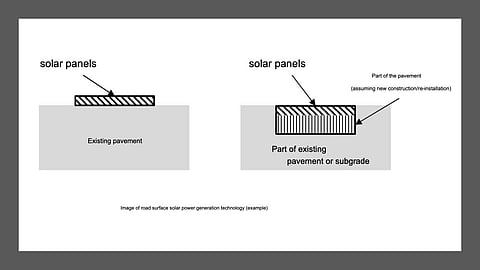
In past tests carried out in Japan, solar panels placed on roads and parking lots developed cracks because of the heavy weight of vehicles. This time, the ministry plans to conduct testing in lighter-load areas – for example, pedestrian walkways at roadside stations, where there is no heavy traffic. These locations are considered more realistic for practical use. The panels can also act as pavement and can be removed and reinstalled for repairs or upgrades, according to the ministry.
The demonstration project will also look at how the generated electricity could be used in real life, through small social experiments. It adds a disclaimer that this call does not certify or approve any company or product, but is only to collect technologies for testing.
The ministry announced the call on December 1, 2025. Submissions for expressions of interest (EOI) will be accepted till December 22, 2025, while technical documents can come in by January 27, 2026.
The project is aligned to support Japan’s target to reach carbon neutrality by 2050 for which the New Energy and Industrial Technology Development Organization (NEDO) unveiled a solar PV power generation development strategy earlier this year (see Japan’s NEDO Identifies Solar PV Challenges To Address).
