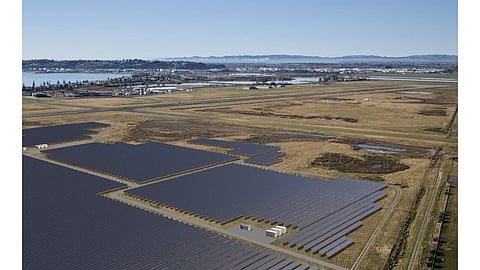


The proposed solar farm at Hawke’s Bay Airport has moved from feasibility work to an EOI process
Planned to be a 12 MW to 17 MW project, it is a scaled-down version of an earlier 45 MW proposal
The airport is now looking for interested partners who will be willing to co-invest in the project
Hawke’s Bay Airport of New Zealand has opened an expression of interest (EOI) process for partners to help deliver and potentially co-invest in a proposed 12 MW to 17 MW solar farm.
The current proposal is smaller than a previously planned 45 MW solar development that Hawke’s Bay Airport and Manawa Energy, now owned by Contact Energy, decided not to pursue. The airport said the change followed work examining feasibility, commercial viability, technical requirements, and business priorities.
It concluded that a smaller project would better match its long-term requirements. “Both parties agreed the best path forward was for the airport to continue developing plans for a smaller, fit-for-purpose solar farm that better aligns with our long-term requirements,” said Nick Flack, CEO of Hawke’s Bay Airport.
Its planned capacity remains subject to environmental and electricity network factors that are still being assessed, according to airport management.
The solar farm is planned for a 24-hectare parcel of airport land northwest of the runways. It is expected to reach a final investment decision (FID) and begin construction around mid-2027, subject to ongoing technical, environmental, consenting, and network work.
Airport management expects project construction to be completed in 2028. On completion, it is expected to generate enough electricity to equal the annual consumption of about 3,000 Hawke’s Bay households.
“This next phase will allow the airport to test market interest and determine the most suitable delivery, ownership and investment structure,” added Flack.
It said feasibility work supports taking the project to market while further work continues over roughly the next 12 months. This includes cultural, commercial, technical, aeronautical, consenting, and community engagement activities.
The EOI is open to companies interested in project delivery, co-investment, or both. A delivery partner would be responsible for EPC, as well as operations and maintenance (O&M). The airport is seeking these services on fixed-price terms, with the proposed O&M arrangement running for at least two years.
A co-investment partner would provide equity alongside Hawke’s Bay Airport and could potentially arrange debt financing. The airport intends to retain ownership of the solar farm, potentially with a partner, to strengthen its long-term revenue base.
The proposed project would connect to the regional electricity network operated by Unison. The EOI document says about 1 kilometer of an existing Unison overhead line will be rebuilt to provide a 33-kilovolt connection for the solar farm. An initial connection application was submitted in late 2025, with final connection approval anticipated in late 2026.
The airport said additional local generation could contribute to regional energy resilience. It also views the project as infrastructure that could support future aviation operations as electricity demand increases.
Interested parties must submit their EOI responses to the call launched on August 26, 2026, by September 28, 2026 at the latest. Hawke’s Bay Airport expects to shortlist parties and seek detailed proposals in early 2027.
