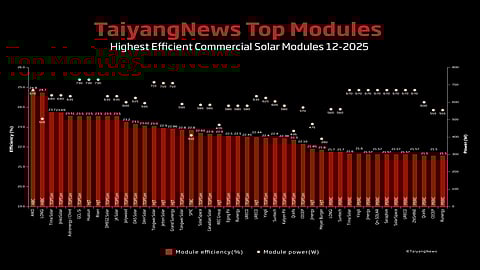


December 2025 recorded the highest number of efficiency updates for the year, with 7 module efficiency improvements captured in a single edition of TOP SOLAR MODULES, several of them occurring at the very top of the ranking.
The efficiency benchmark moved higher again, led by AIKO’s new record of 24.8% at 670 W, followed closely by LONGi’s EcoLife module at 24.7%, which is based on a hybrid BC architecture
JinkoSolar also reached a new high of 23.69%, but remained at the 3rd rank, similar to AIKO and LONGi retaining the top 2 positions despite their efficiency gains
Mid-table efficiencies became more concentrated, with Astronergy reaching 23.51%, GCL SI (TOPCon) and Risen (HJT) both reaching 23.5%, joining an already crowded efficiency band
Jolywood presented an update after more than 2 years with the commercialization of 23.2% module
PERC continues to exit the high-efficiency landscape, as 2 more PERC-based products from Canadian Solar and GCL SI were delisted
Module efficiency remains one of the most important indicators of technological progress in the solar industry. Over the past years, several leading manufacturers have consistently raised the efficiency levels of their commercial modules, a development closely tracked through TaiyangNews’ TOP SOLAR MODULES ranking. In this context, this year-end version of the TOP SOLAR MODULES feature stands out with as many as 7 efficiency improvements, the highest number observed in a single update this year. And, several of these gains occurred at the very top of the table, underscoring how intensively leading players continue to push performance boundaries even at record efficiency levels.
Looking more closely at the latest changes, AIKO has once again reset the benchmark by commercializing a back-contact (BC) module with a record efficiency of 24.8%, paired with a rated power of 670 W. Close behind, LONGi also reached a new high with the commercialization of its EcoLife series module, achieving 24.7% and a power rating of 505 W.
The EcoLife series is built on hybrid BC passivation technology, which is also the underlying cell technology that has achieved the highest crystalline solar cell efficiency to date. The next change took place 2 steps down in the table. JinkoSolar increased the efficiency of its latest commercial TOPCon module to 23.69%. All 3 efficiency updates, while significant, have not impacted the rankings. The 23.51% efficiency level previously held by JinkoSolar is now occupied by Astronergy, reflecting another new entry in this month’s update that is accounted for by TOPCon. This month also sees 2 companies freshly reaching the 23.5% efficiency level – GCL SI with its TOPCon and Risen with its HJT module. This edition also features an update from Jolywood, one of the early adopters of TOPCon technology. After a gap of more than 2 years, the company has updated the commercialization details of its latest product, which achieves an efficiency of 23.2%.
On the downside, the list shrinks once again by 2 entries, following the delisting of 2 PERC-based products, one each from Canadian Solar and GCL SI.
As part of this TOP SOLAR MODULES feature, we would also like to acknowledge last year’s efficiency leaders, highlighted through the updated TaiyangNews Badge of Excellence released in January 2025. As part of the TOP SOLAR MODULES Analysis Report 2024, summarizing the findings from an analysis of 24 editions published throughout 2023 and 2024, we also announced the names of the companies that are eligible for the Badge of Excellence, which was started in 2023 and extended to 2024. The rules of the game remain the same – manufacturers who have featured in the Top 10 for at least 6 months within a calendar year are eligible to apply for this badge. The winners of the TaiyangNews Badge of Excellence 2024 are: AIKO, Astronergy, DMEGC Solar, Huasun, JA Solar, JinkoSolar, LONGi, Maxeon, SPIC, and Tongwei Solar. We will announce the winners of the TaiyangNews Badge of Excellence 2025 in the TOP SOLAR MODULES Analysis Report 2025, to be released by the end of the year.
Background
Efficiency and output power are the 2 key characteristics of a solar module. While there are several ways to improve module power, such as employing larger cell sizes or integrating more cells into a module, it’s the efficiency that truly speaks to the ability of the solar device to convert sunlight into power per area. That’s why this list includes only the highest-efficiency solar modules.
TaiyangNews has been diligently tracking the efficiency progress of solar modules through its annual reports on Advanced Module Technologies, a series that began in 2017. We also provide in-depth coverage of cell and module technology updates in our annual High Efficiency Solar Technologies Conference, the most recent of which took place in December 2025 (access the presentations here).
However, the solar sector is characterized by rapid change, with significant advancements occurring throughout the year. We capture these developments through the various events we organize on different topics. To synthesize this information and provide our readers with frequent updates on global module efficiency progress, TaiyangNews launched this monthly column on commercial TOP SOLAR MODULES at the beginning of 2022.
Furthermore, as mentioned above, TaiyangNews publishes reports analyzing this monthly list, the latest of which was released in June 2025 (see TOP SOLAR MODULES Analysis Report H1 2025).
Methodology
Before going into the details, here is some background on the methodology and selection criteria: module efficiencies have been improving considerably in recent years. In order to make the list rewarding for technically advanced products, we set 21.5% as the minimum efficiency criterion to feature in the list. We have listed only commercially available top solar modules from each cell technology stream of a module maker. For example, if a company is offering 2 different product streams based on PERC that have more than 21.5% efficiency, then only the product with the higher efficiency is considered for this list. However, if a module maker offers, for example, products based on PERC and TOPCon with efficiencies of 21.5% or above, then both products are listed. Efficiency is the only criterion for ranking in the list (whenever available in the specs, we have used 2 digits after the decimal point for efficiencies; otherwise, one). However, as we see products with the same efficiency more often, power determines the order in this case. And when both efficiency and power are the same, we list the manufacturers in alphabetical order.
The list does not distinguish between different module formats. All typical module sizes used in rooftop and ground-mounted solar system applications are included and treated equally, as companies increasingly use larger modules also for rooftop applications.
We only list modules that are based on the manufacturer’s cells produced in-house, which means modules using externally sourced cells are not featured in the TOP SOLAR MODULES list. Having the complete data sheet listed on its manufacturer’s website is the first step for a module to be considered a commercially available product. As such, the efficiency and power data listed here are taken from the datasheet available on the respective company’s website. This also means that any new product announcements without final technical data published are not included in the list, as their module specs often differ considerably from the products that are finally available for purchase, and some products presented at trade fairs do not even see commercial light at all. However, just the existence of an online datasheet generally does not suffice, especially for top efficiencies in the respective technology stream. If module specs listed on the websites appear to have ‘conspicuously’ high efficiencies or new record-efficiency products are announced, we ask for additional proof of commercialization before we include a product in the list.
Results & Changes
The December 2025 edition of TaiyangNews’ TOP SOLAR MODULES features 45 high-efficiency products – 2 fewer than in the previous month – from 33 companies. However, the current edition features a wave of efficiency improvements. Below is the summary:
AIKO again raised the bar, achieving a new efficiency level of 24.8%, closely followed by LONGi at 24.7%, both based on BC. As many as 4 TOPCon products reached new highs – JinkoSolar with 23.69%, Astronergy with 23.51%, GCL SI with 23.5%, and Jolywood with 23.2%. The December 2025 list also saw a dip in the listed product due to the delisting of 2 PERC products.
AIKO improved the efficiency from 24.4% to 24.8% with a rated power of 670 W
LONGi commercialized its EcoLife series module with hybrid back contact passivation achieving 24.7% and a rated power of 505 W
JinkoSolar improved its efficiency from 23.51% to 23.69%, and its rated power from 635 W to 640 W
Astronergy dropped in as a replacement for the vacancy created by JinkoSolar, featuring a module with 23.51% efficiency and 635 W power
GCL SI also improved its top product efficiency, reaching 23.5% and 730 W
Risen is another entrant to the 23.5% efficiency band, commercializing its latest HJT product series
Jolywood took a big leap in efficiency with its latest 23.2% efficiency module, thus also in the ranking
The current edition also saw 2 product delistings – PERC modules from Canadian Solar and GCL SI
These changes have revised the rankings of several products, while a few have posted notable efficiency gains without any change in their positions. The most prominent example of this is at the very top of the TOP SOLAR MODULES ranking.
AIKO has once again set a new record, improving its module efficiency from an already high level of 24.4%. For the current listing, the company has provided commercialization details for a module rated at 24.8% efficiency and 670 W from the Comet 3N72 series with the model name AIKO-A670-MDE72Mw. The product's physical configuration, however, remains the same as its predecessor, G660-MCH72Mw, resulting in the same overall module dimensions.
AIKO has made the top seat its own since its debut on the list in March 2023, with its ABC series module boasting an efficiency of 23.6% at the time. It further cemented its position in June 2023 by breaking its own record with another ABC series module, achieving a landmark 24% efficiency for a commercial product. Again, after about a year, in May 2024, AIKO continued its dominance with the latest Comet 2U series, featuring 24.2% efficiency and 655 W power. The Comet 2U series module, rated at 655 W, was a step up from AIKO’s ABC modules. Built with 144 half-cells of the M10 format, it introduced a larger module footprint, with the length extended from 2,278 mm to 2,382 mm, while the width remained at 1,134 mm. This increase in size contributed to a 35 W power gain over its 620 W predecessor. It is a monofacial module featuring a grid-free front design for improved aesthetics and uniform appearance.
In June 2025, AIKO raised the bar once again by commercializing the AIKO-G660-MCH72Mw module, which maintained the same form factor as its predecessor, featuring identical dimensions, a monofacial design, and a grid-free front that gives it a uniform and aesthetically pleasing appearance. While the structure remained unchanged, both power and efficiency improved, with power increasing from 655 W to 660 W and efficiency from 24.2% to 24.4%. In this edition, the company reaches a new high of 24.8% with the commercialization of AIKO-A670-MDE72Mw.
LONGi also continues to remain 2nd despite a significant improvement from 24.2% to 24.7%, a jump of 0.5 percentage points in efficiency with its recently commercialized EcoLife residential product. This BC module is built on LONGi’s hybrid interdigitated back contact (HIBC) technology, which essentially uses TOPCon and HJT passivated contact structure for each polarity. The technology is also the basis of the highest crystalline silicon cell efficiency of 27.3%, a current world record in the single junction category. More details about this technology can be found at LONGi's recent talk at the TaiyangNews High-Efficiency Solar Technologies 2025, The listed product is packed with 108 half-cut cells in a 1,800 × 1,134 mm² module area and a double-glass configuration with 2 mm and 1.6 mm glass on the front and rear sides, respectively. It uses an anodized aluminum frame and weighs 23.5 kg. The product achieves a maximum efficiency of 24.7% and a power of up to 550 W. The power degradation specified for the product in the first year is less than 1% and a 0.35% annual degradation, with a power attenuation of 88.85% at the end of 30 years.
LONGi had held the 3rd place since May 2023, when its Hi-MO 6 module improved from 22.8% to 23.2% efficiency. In March 2025, the company moved up to share the 2nd position with Maxeon after commercializing its Hi-MO 9 module featuring 24.1% efficiency. In June 2025, LONGi improved it again by commercializing a new high-efficiency module reaching 24.2%. As a result, LONGi surpassed Maxeon and has held sole possession of the 2nd place ever since.
The previously listed product, the Hi-MO 9 module, was based on LONGi’s proprietary HPBC (Hybrid Passivated Back Contact) cell technology. This product utilizes the company’s TaiRay wafer and BC technology. The product, named LR8-66HYD, which replaced its predecessor LR7-72HYD in the listing, has the same external dimensions of 2,382 × 1,134 × 30 mm and a weight of 33.5 kg. However, LR8-66HYD is built with 132 half-cut cells, compared to the 144-cell layout of its predecessor. It achieves a maximum efficiency of 24.2% and a power output of up to 655 W, slightly higher than the earlier model’s 24.1% and 650 W. Despite the reduced cell count, the listed module delivers improved performance, likely due to a change in the wafer configuration apart from design and material enhancements.
After a significant achievement in efficiency in November, Trinasolar remains at the 3rd position with no changes this month. Last month, Vertex N series module efficiency was improved from 23.2% to 23.7%. The TSM-NEG19RC.20 module is built with 132 half-cells based on 210R wafers, unlike Trina’s previous listing, which was based on a 210 mm side length wafer. This 640 W module uses 2 mm glass on both sides and offers a bifaciality of 80±5%. Keeping these core specifications unchanged compared to the previously listed TSM-NEG21C.20, the module achieves improved efficiency through the rectangular wafer format. With this new product, Trinasolar has surpassed other TOPCon players, achieving the highest module efficiency of 23.7%.
The Vertex N series replaced the previous Vertex S+ in September 2023. Back then, while both product groups had the same efficiency, the former offered a higher power output of 700 W compared to 450 W for the latter. As a result, the company’s ranking among products with 22.5% efficiency rose from the penultimate position to 2nd from the top in this group in May 2024. It went on to achieve 23% in May 2025, and then 23.2% in October 2025.
JinkoSolar improved its module efficiency to 23.69% and remains in 4th. This bifacial module is built with 132 half-cells based on n-type monocrystalline TOPCon architecture and incorporates the company’s HOT 3.0 cell design for enhanced light trapping, current collection, and reliability. It uses 2 mm glass on both sides, achieves a bifaciality of 80±5%, and is backed by a 30-year linear power warranty with only 0.4% annual degradation after the first year.
The company first commercialized its Tiger Neo (JKM625–635N–66HL4M-BDV) TOPCon module in July 2025, debuting with 23.32% efficiency and a 630 W power rating. Until then, the company was represented by a 22.65% product, ranked well below the Top 10. With this major upgrade, JinkoSolar’s ranking jumped sharply from 14th to 5th in July 2025, making it to the top of the listed TOPCon modules.
Within just 3 months, the company further enhanced the module’s performance, increasing efficiency to 23.51% and power to 635 W. As a result, JinkoSolar climbed another step up to 4th place in the October edition, marking a significant milestone, as it was the first time a TOPCon module surpassed the top HJT efficiency benchmark within the TaiyangNews TOP SOLAR MODULES rankings. In the November edition, Jinko was surpassed by Trina’s TOPCon module. However, JinkoSolar remains at Rank 4 with Trina replacing Maxeon at Rank 3.
Looking back, JinkoSolar’s trajectory over the past year illustrates how quickly its module efficiency has advanced: the company dropped from 9th to 11th in the July 2024 edition, slipped further to 12th in October, to 13th in May 2025, then to 14th in June 2025, before its major leap to 5th in July 2025 following the introduction of the Tiger Neo series.
Despite the changes discussed above, the ranks among the top 4 remain unchanged, while the first change takes place at 5th.
Astronergy improves its module efficiency from 23.3% to 23.51% in the December edition, and is now ranked 5th, up from 8th in the previous edition.
Previously, it improved from 23.1% to 23.3% in September 2025. Over the past 2 years, Astronergy has progressively improved its module efficiency. The previous ASTRO N5 variant, introduced in September 2023, had its efficiency upgraded from 22.5% to 22.6%, and later to 22.8% by March 2024. By November 2024, the company commercialized a high-power 640 W version with 22.9% efficiency, achieved by increasing the cell count from 144 to 156, which also resulted in larger module dimensions (2,465 × 1,134 × 30 mm).
In March 2025, the ASTRO N7 series entered the listing with an efficiency of 23%, replacing ASTRO N5 and improving the company’s ranking from 7th to 5th. The bifacial TOPCon module comprises 132 half-cut cells based on 182 mm rectangular wafers. At 2,382 mm, the N7 module is slightly shorter than the previous model, while its width and thickness remain the same at 1,134 mm and 30 mm, respectively. It has a bifaciality of 80±5%.
In the July 2025 edition, Astronergy further improved the module’s efficiency to 23.1% and its power to 625 W. Despite these improvements, the module’s ranking dropped from 6th to 7th in July 2025, overtaken by JinkoSolar’s module mentioned above. In September, with efficiency reaching 23.3%, Astronergy reclaimed 6th place. However, in the October 2025 edition, it moved 2 steps down to 8th, which was held until November 2025. In this edition, Astronergy is placed at rank 5, with 23.51% efficiency and 635 W power.
With a negligible difference of 0.01%, 23.5% efficiency slot has been pushed down by a place to 6th rank, but the number of products listed at this level increased from 3 to 5. And GCL SI is one of the 2 new entrants to the 23.5% club.
GCL System Integration (GCL SI), a subsidiary of the vertically integrated GCL Group, the globally recognized silicon supplier to the solar industry, provides solar modules, battery storage products, and complete PV solutions.
For this edition, the company has provided the commercialization details of a high-efficiency product, GCL-N12/66GDF, from the same product series, with a close to 1% absolute improvement in efficiency. The latest product has a rated efficiency of 23.5%, improved from 22.53%, and a power rating of 730 W. The company, however, has not elaborated on the technology improvements that led to this significant gain.
In the July 2023 edition, 2 modules from its GCL GEMINI series were listed – one based on TOPCon and the other on PERC technology. In April 2024, the GEMINI TOPCon module was replaced with a GCL LOTUS series module, although the core specifications remained unchanged. In October 2024, this product dropped from 28th to 29th, tying with Qcells for the rank. GCL SI regained the 28th position in January 2025, as the number of companies at this position fell from 3 to 2 following REC’s move up in July. In June 2025, the listing was updated with a new commercial product – GCL-NT12/66GDF, which remains the current product's model name. This bifacial, half-cell module features n-type TOPCon technology, built on a 210 mm wafer format with 132 cells. It delivers a rated power of 700 W and achieves a module efficiency of 22.53%. With this upgrade, the company’s ranking improved significantly, jumping from 28th to 17th. In the September 2025 edition, this module moved to 19th, and it dropped another rank to 20th in October 2025. In November 2025, the product was up a place to 19th. GCL SI’s PERC product, which was listed at 38th rank in the previous editions, is no longer available on its website. Hence, the product is delisted from this edition.
Risen, the second company featuring at this efficiency level for the first time, presented a significant change in this edition. The company provided the proof of commercialization for its latest Hyper-ion Pro series product, RSM132-8-730HDG, with an efficiency of 23.5%, which is higher by a whole 1% (absolute) than the previously listed product’s 22.5% Thus, the company’s ranking leaps from 21st to 6th position.
Risen Energy’s Hyper-ion HJT module, included in June 2023, featured an efficiency of 22.5%, corresponding to a high rated power of 700 W. This bifacial product consists of 132 half-cells, cut from the original 210 mm format.
The current improvement is a result of collective advancements at the cell and module levels. Starting at the cells, the structure features microcrystalline silicon passivation layers on both the front and rear sides. As for advancements in metallization, it features a fine finger width, increasing the light-absorption area. The module is based on a ZBB interconnection layout. All these developments enable the module to reach a power rating of 730 W. The module is built on 132 half-cut cells based on the 210 mm wafer, with a bifaciality of 90±5%, and uses 2 mm double-glass. The module measures 2,384 x 1,303 x 30 mm and offers a 1% degradation warranty in the first year and a power attenuation of 90.3% after 30 years. Risen presented its product and technology advancements at the recent TaiyangNews High-Efficiency Solar Technologies 2025 held in December.
Huasun’s product ranking dropped to 6 from its previously held 5th position, with a TOPCon product surpassing it in this edition. The company’s HJT module, introduced in September 2023, moved up to the 4th position in May 2024, thanks to improved efficiency and power ratings. Until August, Huasun’s top product was listed with 22.53% efficiency and 700 W of power. The Himalaya series module from Huasun is based on the G12 wafer size in a 132-half-cell configuration. The first to surpass the 700 W threshold on our list, the product later improved to 23.18% efficiency and 720 W power output in August 2024.
Commercializing an upgraded version of this module with 23.5% efficiency and 730 W of power, Huasun raised the bar in the June 2025 edition, maintaining its claim to the highest power rating among all modules listed in the TOP SOLAR MODULES ranking. This bifacial module features 2 mm double-glass and boasts a bifaciality of 90±5%, making it particularly well-suited for utility-scale applications. It measures 2,384 × 1,303 × 33 mm, weighs 37.9 kg, and is backed by a 15-year product and a 30-year power warranty.
Although its specifications remained unchanged in the October 2025 edition, the product’s ranking stepped down to a joint 5th, following JinkoSolar’s rise to 4th place. Huasun shares the 23.5% efficiency band with GCL SI, Risen, DMEGC Solar, and JA Solar, with the latter pair improving the top efficiencies of their commercial offerings in October 2025.With Astronergy’s TOPCon moving up with improved efficiency, Huasun’s rank drops to 6th in the current listing.
DMEGC Solar achieved a notable upgrade in October 2025, improving its Infinity RT TOPCon module to 23.5% efficiency and a 635 W power output from the previous 23% and 620 W. The company’s Infinity series TOPCon module, which was updated in April 2024 with 22.6% efficiency, was replaced by the Infinity RT series in July 2024. This module is built on the 210 mm rectangular wafer format and a 132-half-cell configuration. Compared to its 182 mm, 144-half-cell configured predecessor, this module has a 30 W higher rated power (610 W) and boasts an efficiency of 22.8%. Having moved up to 6th from 10th in July 2024, this module dropped to 7th in October and then to 9th in November 2024. An improvement in its efficiency to 23% in March 2025 pushed it up to 5th, where it was grouped with several other TOPCon modules. All these modules dropped a step to 6th in June 2025, to 8th in July, and further to 10th in September 2025. In the October 2025 edition, the product upgrade elevated DMEGC Solar back into the Top 5, sharing the 23.5% efficiency band with Huasun and JA Solar. The module’s dimensions are 2,382 × 1,134 × 30 mm, and it weighs 32.3 kg. The 2 mm double-glass module features a bifaciality factor of 80±5%. With Astronergy’s jump to rank 5, DMEGC’s position moves down to 6th in the current edition.
JA Solar improved its TOPCon module efficiency in October 2025 from 23.3% to 23.5%, also raising the power output from 630 W to 635 W. JA Solar commercialized a high-efficiency TOPCon module – JAM66D45 630/LB – with an efficiency of 23.3% in September 2025.
Previously, the JAM72D40 series, which entered the list in July 2024 at 22.8% efficiency, was raised to 23.0% in November 2024, and further improved to 23.2% in June 2025. Before that, JA Solar had been represented by the JAM72D42 630/LB, which had remained unchanged since August 2023 after replacing the earlier JAM66D45 630/LB.
The currently featured JAM66D45 635/LB measures 2,382 × 1,134 × 30 mm and weighs about 33.1 kg. It is a bifacial double-glass module with a bifaciality of 80±10%, consisting of 66 full cells (132 half-cells) based on JA Solar’s rectangular M10 wafer platform. The module is interconnected via 16 busbars and is rated for a power output of 635 W at 23.5% efficiency. Compared to the previously featured JAM72D40 600/MB, which adopted the smaller 94 mm half-cell format in a shorter 2,278 mm, 72-full-cell (144 half-cell) module, the current product employs the larger 99.5 mm half-cell format. While these are also the features of the previously listed module, the current product features an improved efficiency of 23.5%. With this, JA Solar has become a part of the 23.5% efficiency club, sharing the 5th rank with Huasun, DMEGC Solar, GCL SI, and Risen, but at 6th rank, with Astronergy moving up.
As the 23.5% efficiency level is shared by 5 products at 6th place, the next position in the ranking shifts to 11th, where the corresponding efficiency for this edition stands at 23.2%. Even this slot reflects an improvement, currently occupied by Jolywood with its latest commercialized model, JW-HD144N-R0-600W. The product, with an efficiency of 22.53% and a power output of 600 W, replaces a module listed in the feature for more than 2 years – JW-HD108N440W, which was rated at 22.3% efficiency and 400 W power. The new module is built with 144 half-cut cells based on 182 mm wafers. This module has dimensions of 2,278 × 1,134 × 30 mm. The temperature coefficient of the module is -0.28%/°C and the bifaciality is 80±5%.
Jolywood, one of the early adopters of TOPCon technology, previously shared its 19th rank with GCL SI. The last change for this product was in August 2023, when its former Niwa Light module was replaced with a bifacial product called Niwa Pro, which has the same specifications – 440 W power and 22.53% efficiency.
DAS Solar first appeared in the TOP SOLAR MODULES list in October 2022 with a product featuring 570 W of power and 22.1% efficiency. This was followed by several quick updates: in April 2023, the company introduced the DAS-DH08NA with 435 W power and 22.3% efficiency; in July 2023, the DAS-DH144NA reached 580 W of power and 22.4% efficiency; and in August 2023, the DAS-DH156NA was launched with 630 W power and 22.5% efficiency. DH156NA then remained in the rankings for almost 2 years before being replaced in September 2025 by the new, higher-efficiency (23.1%) DAS-DH132NE. With this update, DAS Solar’s ranking catapulted from 19th to 8th. In the October 2025 edition, while its efficiency and power ratings remain unchanged, the company’s rank slipped to 10th, but moved up to 9th in November due to the changes with respect to other products in the listing. In the current edition, several efficiency improvements have pushed DAS Solar to rank 12th.
DAH Solar, a new entrant in the TOP SOLAR MODULES list in September 2025, made its debut at the 9th rank. Headquartered in China, the company is recognized for its balcony solar kits and its patented Full-Screen module design, which eliminates the front frame to reduce dust accumulation. This product is a Full-Screen TOPCon module that achieves 23.02% efficiency, reaching a maximum power of 595 W. Built on the 182 mm wafer format in a 132 half-cell configuration, the module measures 2,278 × 1,134 × 30 mm and weighs about 30.7 kg. It features a dual-glass construction, offers a bifaciality of around 80%, and comes with a 30-year linear power warranty. In the October 2025 edition, following the above efficiency upgrades, DAH Solar’s ranking moved to 11th, 10th in November and 12th in this edition.
With the latest round of module upgrades, most manufacturers have moved beyond the 23% efficiency range. The 23% band, previously shared by Trinasolar, Tongwei Solar, and DMEGC Solar, is now represented solely by Tongwei Solar, which holds the 14th rank in the current edition.
In December 2023, Tongwei Solar also started offering a 715 W HJT module, which entered the list ranked 4th. It then moved to 5th in May 2024 and to 6th in June 2025. Until November 2023, Tongwei was represented only in the TOPCon and PERC (shingled) segments. With the inclusion of this HJT product, Tongwei became one of the few companies to have featured simultaneously in all 3 different technology streams in our listing. However, the delisting of its PERC module in September 2024 narrowed its representation to 2 streams.
Tongwei’s HJT module is built with 132 half-cells of the 210 mm format. It is designed with the company’s THC cells – an n-type HJT cell technology. The highest power rating for this bifacial module is 715 W, with an efficiency of 23%. Tongwei has also provided production details and a testing report for this panel. The company presented the details of its current technologies and future technology roadmap at the TaiyangNews High-Efficiency Solar Technologies 2025 Conference, and they can be accessed here.
Jetion Solar, which held the 13th position since September 2025, moved up to 12th in November. Due to the efficiency improvements above, it now moves down to rank 15.
Established in 2004 and operating under the China National Building Materials Group Corporation (CNBM), Jetion is a vertically integrated PV manufacturer with production capabilities spanning solar cells and modules. The company operates 5 manufacturing facilities across China and Thailand, with a total cell production capacity of 4.4 GW and a module capacity of 2.5 GW.
Jetion Solar joined the listing in June 2025 at the 10th position with its HJT module, featuring a rated maximum efficiency of 22.9% and a power output of 710 W. Its JT SLk(B) series module features bifacial, dual-glass HJT technology and incorporates 132 half-cut monocrystalline cells based on the 210 mm wafer format. It measures 2,384 × 1,303 × 33 mm and weighs 36.4 kg. The module offers a bifaciality factor of approximately 90±5% and utilizes 2.0 mm high-transmission, AR-coated tempered glass on both the front and rear sides. It is backed by a 15-year product warranty and a 30-year linear performance guarantee. Its Top 10 debut in June, however, was short-lived, being pushed to 11th in the July edition due to efficiency improvements by other manufacturers.
Grand Sunergy, a China-based manufacturer specializing in HJT cell manufacturing, entered the renewable energy sector in 2022. Its HJT module first appeared on the list in October 2024 with an efficiency of 22.86%, initially ranked 6th. Subsequent efficiency updates from JA Solar and Astronergy in November 2024 led to a drop in its position to 8th, followed by another shift to 9th in March 2025. With Trinasolar improving its module’s efficiency in May, the module moved down to 10th. Jetion Solar’s entry in June pushed it further to 11th, and another place to 12th in July 2025, following efficiency gains from JinkoSolar and Astronergy. With more efficiency improvements from other companies in the September edition, it moved to 14th rank, and up to 13th in October. In the current edition, it is ranked 16th.
The company’s GSM-MH3/132-BHDG710 module, which delivers a power output of 710 W, utilizes G12 large-size wafers and measures 2,384 × 1,303 × 33 mm, weighing 38.5±0.5 kg. It features a bifaciality of 85% and is supported by a 30-year linear power warranty.
The next efficiency band on the list is 22.8%. Represented by 5 products in July 2024, the number reduced to 3 in November 2024 after Astronergy and JA Solar advanced to higher-efficiency groups. In July 2025, DMEGC’s move to the 23% class further reduced the count to 2. There has also been a steady decline in the band’s rank – from 9th in November 2024, to 10th in March 2025, 11th in May, 12th in June, 13th in July, and further down to 15th in September 2025. Some reshuffling at the top helped it improve to 14th rank in November 2025, but it now drops down to 17th, given the adjustments in the listing above. This group is now represented by only 2 products, one from Tongwei and the other from SPIC.
Tongwei Solar updated the efficiency of its TOPCon panel in February 2024. The module, which entered the list in April 2023, improved its efficiency from 22.5% to 22.8% and power from 580 W to 590 W. These improvements enabled its move from 10th place to 6th. However, Grand Sunergy’s entry in October 2024 shifted it down to 7th, with further declines to 10th in November and 11th following Trinasolar’s May update. In June 2025, it was pushed to 12th, to 13th in July 2025, and to a further 15th in September 2025. In November, its rank improved to 14th; however, it drops to a shared 17th in the current edition. The product is designed with a TNC cell type and an anodized aluminum alloy frame, and features a 30-year linear power output warranty. This product is built with 144 half-cells of the G12 wafer format.
SPIC is the other occupant of the 22.8% efficiency level. Ranked 6th from December 2023 until September 2024, SPIC moved down to 7th in October and to 9th in November, alongside its fellow rankers. With subsequent advancements by LONGi, Astronergy, and DMEGC Solar, the rankings of Tongwei and SPIC both slipped to 10th in March, then to 11th in May, 12th in June, to 13th in the July 2025 edition, to 15th in September, and subsequently to 14th in November 2025. In the current edition, its ranking moves down to 17th, along with Tongwei’s product.
While SPIC had been promoting a product with 22.3% efficiency until August 2023, it made a remarkable change in September 2023, improving it by 0.5% absolute. Its Andromeda 3.0 product series has a rated top efficiency of 22.8%. The module features an elegant full-black design combined with SPIC’s TBC cell technology, which is an IBC concept adopted on a TOPCon base cell architecture. The module, with a bifaciality of 70% and built with 120 half-cells, has a power rating of 410 W. SPIC offers a 30-year power warranty for this product.
SolarSpace, a leading cell manufacturer that has ventured into module production, is represented in our listing with both PERC and TOPCon modules. The Lumina II TOPCon module, which entered the rankings in July 2023, was upgraded in December 2023 to a high-efficiency variant, increasing its efficiency from 22.02% to 22.45%. In November 2024, the company further enhanced the top efficiency of its commercial TOPCon offering to 22.65%, resulting in a significant jump in its ranking from 20th to 12th. However, subsequent updates from other companies pushed it down to 13th in May 2025, 14th in June, 15th in July 2025, and to 17th in the September and October 2025 editions, and ranked 16th in November. In this edition, its ranking drops to 19th. This 580 W module is composed of 144 half-cells of the 182 mm wafer format. Additionally, SolarSpace’s Lumina I, a PERC module with an efficiency of 21.57%, is one of 6 products tied for the 37th rank on the list. Its SS9-66HD bifacial PERC module’s ranking moved up by 2 steps with the delisting of 2 PERC products in this edition.
In October 2025, Canadian Solar improved the efficiency of its existing TopHiKu6 TOPCon module from 22.5% to 22.6%, along with a corresponding power increase from 580 W to 585 W. As a result of this improvement, the company’s ranking also improved from 21st to 18th, tying with REC Solar. While both companies moved up to 17th in the November edition, they are ranked 20th in the current listing.
The TopHiKu6 series first entered the TOP SOLAR MODULES listing in June 2023, with the CS6W-580T variant achieving 22.5% efficiency, replacing an earlier 22.3% efficiency bifacial module. The current CS6W-585T module comprises 144 half-cells based on the 182 mm wafer format and a bifacial configuration.
In July 2024, REC Group, the Singapore-based manufacturer, made a significant update to its product lineup by commercializing the new bifacial Alpha Pure-RX module. This module replaced its predecessor, the Alpha Pure-R series, in our listing. This HJT module boasts an efficiency of up to 22.6% and a power output of 470 W. Designed with foil-wire combination interconnection technology, the Alpha Pure-RX is significantly improved compared to its predecessor, which had an efficiency of up to 22.3% and a module power of 430 W. As a result of this advancement, REC’s ranking jumped from 27th to 12th and then a couple of places down to 14th in November. It slid to 15th in May 2025, to 16th in June, 2 places down to 18th in September, and up a place to 17th in November. Currently, REC is ranked 20th in the listing.
The Alpha Pure-RX module is built with 88 half-cut bifacial HJT cells, compared to 80 cells in the Alpha Pure-R, contributing to its higher power. The physical dimensions of the Pure-RX module are slightly larger, measuring 1,728 × 1,205 × 30 mm and weighing 22.7 kg, compared to the Pure-R’s 1,730 × 1,118 × 30 mm and 21.5 kg. It also features a bifaciality of 80±10%. Constructed with a highly resistant black polymer backsheet and an anodized aluminum frame, the module is manufactured in Singapore and is accompanied by a comprehensive 25-year product and power warranty.
The next group of products at 22.5% efficiency saw the number of companies sharing this spot considerably reduced over time, from 7 to 6 in July 2024, with the collective ranking slipping from 15th to 16th in November 2024. In May 2025, Trinasolar’s advancement to the higher 23% efficiency band further reduced the count to 5, leading to another drop in the group ranking to 17th. In June, the group’s position slipped further to 19th. In September 2025, DAS Solar’s improvement reduced the number of companies to 4, with the group ranked 21st. In the October 2025 edition, following Canadian Solar’s efficiency improvement to 22.6%, the number of companies in the 22.5% band further decreased to 3, and the collective group ranked 22nd. In November, due to Maxeon’s product delisting, the group’s rank moved up to 21st. With Risen Energy’s efficiency update, the group members are now reduced to only 2 – EGING PV and Runergy – and their rank drops to 22nd.
EGING PV improved its TOPCon module efficiency slightly in May 2024. Also from its Star Pro series, the company’s best TOPCon product has an efficiency of 22.5%, increased from 22.45%. This bifacial module, comprising 144 half-cells of the 182 mm wafer format, maintains its power rating at 580 W.
Runergy’s TOPCon module, initially listed with an efficiency of 22.4% until November 2023, was upgraded to 22.5% in December, resulting in a significant jump from 21st to 10th place. The ranking gradually declined thereafter, dropping to 12th in April 2024, 14th in July, and to 17th in November. It then moved down to 19th in June 2025, to 21st in September, to 22nd in October, and improved to 21st in November 2025. Due to the efficiency updates above, it is currently placed at 22nd.
Runergy, a major Chinese cell manufacturer that expanded into module production, had both its TOPCon and PERC products featured in the listing for the first time in July 2023. The listed TOPCon module, HY-DH144N8, is a bifacial product built with 144 half-cells using the 182 mm wafer format and offers a maximum efficiency of 22.5%.
URECO is a manufacturer formed from the merger of 3 leading Taiwanese cell manufacturers – Neo Solar Power, Gintech, and Solartech. The company offers products based on all 3 mainstream cell technologies – PERC, TOPCon, and HJT. While its PERC products were already part of our earlier listing, the modules based on the 2 remaining advanced cell technologies were included in our August 2023 edition. Named GLORY, the company’s TOPCon series is represented by its FBF580B8D model, featuring an efficiency of 22.45%, which places it at 24th rank. Following the delisting of Qn-SOLAR in October 2025, this module is now the sole representative of the 22.45% efficiency level, once represented by 4 companies. URECO’s HJT module, with a rated efficiency of 22.44%, very narrowly misses the spot by 0.01%. Called GLORY HELLO, the module is built with 120 half-cells of the 210 mm wafer format and has a power rating of 635 W. This module is listed 1 rank below its peer, at 25th. Previously, its rank went up by 1 due to the delisting of Qn-SOLAR. All the products down the list from here improved their rankings due to the exclusion of Qn-SOLAR’s TOPCon product.
Yingli Solar is one of the early adopters of n-type wafer-based cell architectures. It has 5 GW of cell production capacity for TOPCon and 20 GW of module capacity for PERC and TOPCon. Yingli entered the list in November 2023 with its PANDA 3.0 PRO, a TOPCon module product that remains unaltered since then. The listed TOPCon bifacial module, comprising 156 half-cells with MBB interconnection, has been rated at 22.36% efficiency and 625 W of power. In the August 2025 edition, its efficiency value was rounded up to 22.4% with no change in power rating, reclaiming its January rank of 27th. After Akcome’s delisting in January 2025, Yingli moved from 28th to 27th, but subsequent efficiency advancements by other manufacturers pushed it down to 29th in June. It briefly climbed back to 27th, slipped to 28th in September, and regained the 27th rank in the October 2025 edition. Currently, it holds 26th place. In addition, Yingli’s YLM 3.0 Plus 1 PERC module, first listed in February 2022, also adopted a new efficiency representation strategy – changing from 21.57% to 21.6% in August 2025. This product now holds the 36th rank in the listing.
Suntech’s module, which saw a change in April 2024, remains unaltered since. The Ultra V Pro Plus module with 625 W was replaced with the lower-power 605 W Ultra V Pro. The latter is built with 132 half-cells, while the former consists of 156 half-cells. While its power output has changed, the module’s efficiency remains at 22.4%, as do its other characteristics, including TOPCon cells and bifacial module technology. Following this update, the module moved from 24th to 25th in October 2024, to 27th in June 2025, further down to 28th in September 2025, back to 27th rank in October 2025, and up another rank in the November 2025 edition. Another Suntech product, a PERC module first listed in July 2023, boasts an efficiency of 21.7% and ranks 33rd, thus making it one of the highest-rated modules in the PERC category.
Kalyon PV, a Turkey-headquartered vertically integrated PV manufacturer from ingot to module, debuted in March 2024 with its TOPCon module at Rank 24, dropped to 25th in July, and then to 26th in October. It moved down to 28th in the June 2025 edition, to 29th in August, to 30th in September 2025, and back to 29th in the October 2025 edition. Currently, the module ranks 28th in the listing, with 22.38% efficiency.
With 4 factories and an R&D center, the company commenced production in 2019. Its TOPCon module, featuring 22.38% efficiency and 580 W power output, utilizes M10 half-cut cell technology and a bifacial module design. Another module from Kalyon, listed in the PERC category from March 2024 until July 2024, has since been delisted.
Qcells re-entered our list in February 2024 with its TOPCon Q.TRON SMART product, which was replaced with a higher power Q.TRON variant the very next month. While its efficiency remains the same at 22.3%, the Q.TRON module delivers 35 W of additional power over the previous one. Interestingly, despite the power increase, the cell count has reduced from 120 to 108. This is only possible when adopting larger wafer formats. The current 108-cell configuration is most likely based on the M10 wafer format, half-cell, and MBB module technology. According to the website, the module is available in the UK region. Qcells shared the 28th rank with GCL SI until May 2025. However, with GCL’s transition to a higher efficiency band in June 2025, Qcells’ module moved to an independent 30th position, followed by another move to 31st in September 2025. In the October 2025 edition, it regained its June position at 30th. In the November 2025 edition, the product ranked 29th in the listing, which remains unchanged currently.
CECEP Solar Technology is a Chinese cell and module producer founded in 2010, operating capacities of around 4 GW for cells and 8 GW for modules, according to its website. The company’s TOPCon product is a High Efficiency series bifacial solar module made with 144 half-cells based on M10 n-type wafers. The product is rated with an efficiency of 22.1% and a power output of 570 W. Although the module’s specifications have seen no changes, ranking shifts among higher-efficiency modules have impacted its placement in the overall list. After moving from 30th to 31st in June 2025 and then to 32nd in September 2025, the module returned to 31st in October 2025. Its rank further improved to 30th in November 2025 and remains unchanged in this edition.
Below 22% Efficiency Group
The remaining 17 products in the list feature efficiencies below 22%, of which 2 are HJT-based, while the bulk, or 15, are PERC modules. The number of PERC modules has been declining recently. In July 2024, Kalyon PV’s PERC module was delisted, followed by Tongwei Solar’s product in September. In October 2024, a module each from Astronergy and Talesun delisted, while JinkoSolar’s module was delisted in December. In total, 5 PERC modules were delisted over H2 2024. In January 2025, 2 PERC modules were delisted, one each from Akcome and Risen Energy. In July 2025, EGING PV’s PERC module was removed from our listing, as its datasheet is no longer available on the company’s website. With JA Solar’s delisting of its PERC product in October 2025, DAS Solar’s PERC module in November 2025, and the delisting of GCL’s and Canadian Solar’s PERC modules in the current edition, the total count of PERC modules now stands at 13, 2 down from 15 in the previous edition.
Jinergy’s HJT module, which was updated in September 2023, is now ranked 31st. Its efficiency of 21.85% is 0.17 percentage points higher than its predecessor. The featured JNHM144-475 model is a slightly larger module compared to the previous one, built with 144 cells, and thus boasts a higher power rating of 475 W. It is bifacial too, with a bifaciality of over 85%.
Meyer Burger is offering its HJT product with the same efficiency of 21.8% and a power rating of 390 W, listed 32nd.
Several module series available today have efficiencies slightly exceeding 21.5%, as high-efficiency cell architectures are not a prerequisite for reaching that level. However, in order to design products beyond 21.7%, cell technology is key.
As shown in our recent TOP SOLAR MODULES Analysis Report, PERC in general was unable to support efficiencies above 21.6% until the end of 2023. At the time, modules with efficiencies above 21.6% usually employed cells based on high-efficiency cell architectures such as IBC, TOPCon, or HJT.
Of late, however, we have observed an increase in the number of companies achieving module efficiencies of up to 21.7% with PERC. Until November 2022, LONGi and Risen were part of this group. Canadian Solar joined the list of 21.7% efficiency PERC modules in January, Tongwei in February, DAS Solar in April, and Suntech in July 2023. However, Tongwei’s PERC module with shingled technology was delisted in September 2024, reducing the number of companies sharing the rank at the time from 6 to 5. In the January 2025 edition, Risen Energy discontinued its PERC module, prompting its delisting, and further reducing the number of companies ranked 34th to 4. With the delisting of PERC products from DAS Solar in November and from Canadian Solar in December, the representation of 21.7% efficiency group further drops to 2 companies – LONGi and Suntech. However, their collective ranking remains at 33, as it was in the previous edition.
LONGi’s Hi-MO 5m is built with 144 cells of 182 mm cell size, offering 560 W of power The second one of the group is Suntech’s Ultra V module has a 144-half-cell design based on the 182 mm wafer format and a rated power output of 560 W.
The next efficiency level is 21.6%, also currently represented by 2 companies, which is also one less than last month. In the October 2025 edition, with the delisting of JA Solar’s PERC module, this efficiency band was jointly represented by GCL SI, Trinasolar, and Yingli Solar’s PERC products, ranking 38th. In November, this trio shared the 36th rank. All the 3 modules shared a power rating of 670 W, featuring 132 half-cells of G12 size. With the details of GCL SI’s PERC product no longer available on its website, it has been delisted and the group now comprises of Trinasolar and Yingli, placed at rank 35 in this listing.
The 21.57% level is currently represented by 6 companies, currently ranked 37th. All these products moved down a position to 42nd in August, to 43rd in September 2025, again to 41st in October 2025, and to 39th position in November 2025. With the 2 PERC products being delisted as mentioned above, the group’s ranking improves to 37 in this edition. Jinergy, Qn-SOLAR, Seraphim, and ZNSHINE leverage bifacial capabilities, while modules from SolarSpace and URECO are not specified. All these products are built with 132 half-cells of the 210 mm wafer format interconnected with MBB. Not just efficiency, these 6 products have the same rated power of 670 W due to the same wafer format and the number of half-cell strips.
The lowest efficiency of 21.5%, which is also the minimum threshold for inclusion in this list, is currently represented by 3 products at rank 43 – Runergy, CECEP, and Qcells.
In the May 2025 edition, Qcells introduced an update with a new high-power PERC module rated at 600 W, replacing its earlier 590 W version. While the efficiency remains unchanged at 21.5%, the power upgrade positions Qcells ahead of Runergy within this group, based on the alphabetical sorting method.
Summary
The December and the last edition of TaiyangNews’ TOP SOLAR MODULES 2025 presents several significant efficiency improvements in all the 3 mainstream cell technologies - BC, TOPCon, and HJT. The most significant improvements appear in the BC segment, with AIKO resetting the record performance with the commercialization of a 24.8% efficiency BC module, and LONGi closely following it with its 24.7% product. LONGi’s latest EcoLife BC module series is built on an innovative hybrid technology that uses a TOPCon and HJT based passivated contacts approach for contact of each polarity, a technology that is also the basis for the world-record crystalline single junction solar cell.
Similar to the trend observed over the last few months, more TOPCon products from leading suppliers are improving their efficiencies and are moving up in the TaiyangNews TOP SOLAR MODULES list. This month has seen Astronergy move from the top 10 to the top 5 in the listing, whereas GCL SI moves from the top 20 into top 10, which is quite significant. A similar jump in efficiency is observed in the case of Jolywood, which was placed at Rank 19 in the last edition, is ranked 11th in this edition. While its rank hasn’t changed, it is interesting to note that JinkoSolar’s product has improved its efficiency by almost 0.2% absolute, missing the top spot among TOPCon modules marginally, at 23.7%.
On the HJT side, Risen Energy has updated its product efficiency to the highest in this technology category at 23.5% and now shares the spot with Huasun’s product.
Another trend that’s becoming more and more consistent is the phase-out of PERC products, with 2 more modules being delisted in this edition. Both Canadian Solar and GCL SI have removed their PERC product information from their respective websites. The trend is expected to continue , at least in case of tier 1 and 2 suppliers.
Reports: If you want to learn more about the commercial module efficiencies of integrated module producers, please check our latest TOP SOLAR MODULES H1- 2025 Report. This TaiyangNews TOP SOLAR MODULES H1-2025 report summarizes the key findings from over 30 editions published during 2023 and H1-2025 and analyzes the trends and developments for the different cell technologies (PERC, TOPCon, HJT, Back Contact) and listed companies (download the TOP SOLAR MODULES H1-2025 report for free here).
