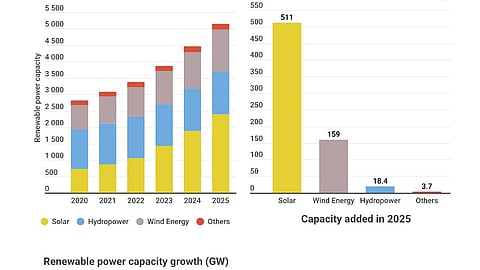


Solar installations globally reached 511 GW in 2025, rising 27.2% YoY and making up nearly 3-quarters of all renewable additions
Renewables delivered 85.6% of total power capacity expansion, with solar and wind overwhelmingly driving growth
Despite record expansion, the world remains over 6 TW short of its 2030 renewable capacity target for the 1.5°C pathway
Solar energy had another record year globally in 2025 with installations totaling 511 GW, expanding by 27.2% year-on-year (YoY). It accounted for close to 75% of the total renewable energy capacity additions of 692 GW that increased by 15.5%, according to the International Renewable Energy Agency’s (IRENA) Renewable Capacity Statistics 2026.
Solar PV alone accounted for the lion’s share of this total, with installations of 510.3 GW. In 2025, solar PV additions totaled 452 GW (see IRENA: A Record 452 GW Solar Capacity Installed In 2024).
The annual report finds that renewable energy was the dominant source of capacity expansion last year, accounting for 85.6% of the total. Together, solar and wind energy (159 GW with 14% YoY increase), accounted for 96.8% of all net renewable energy additions, ‘reflecting the biggest cost decrease among all renewable technologies’.
The remaining additions came from 18.4 GW of renewable hydropower, 3.4 GW of bioenergy, and 300 MW of geothermal energy. Last year saw the highest annual increase in total renewable generation capacity to date and the highest percentage growth on record, it adds.
At the end of last year, global cumulative installed renewable power capacity reached 5.149 TW, split into 2.39 TW of solar, 1.29 TW of wind and hydro, 154 GW of bioenergy, 16 GW of geothermal, and 500 MW of marine power.
With this, the world is now 6.02 TW away from reaching its 11.17 TW total renewable energy capacity target by 2030 to be on track for the 1.5°C Scenario, according to IRENA.
Once again, IRENA points to the geographical disparity in the renewables spread. Asia, thanks to China, remains on top with 2.89 TW of the total, followed by Europe at 934 GW. The lowest share, at 21 GW, is that of Central America and the Caribbean.
Excluding the European Union (EU), the G7 nations accounted for 22.1% of the global capacity share of 1.14 TW.
In 2025, Asia led with 513.3 GW capacity additions out of 692 GW. In comparison, Africa had its highest capacity increase, at 15.9%, with 11.3 GW added, led by Ethiopia, South Africa, and Egypt. According to the Global Solar Council (GSC), Africa’s solar market expanded by 4.5 GW in 2025 (see Africa’s Solar Market Accelerates Sharply In 2025, Adding 4.5 GW).
The Middle East renewables market expanded by 28.9% YoY, reaching a cumulative 56 GW with 12.7 GW added last year.
Nevertheless, renewables continue to expand consistently, proving their market preference and resilience. Referring to the geopolitical tensions, including the escalation in the Middle East, IRENA stressed that renewables reduce exposure to international fuel markets and build more resilient systems that are less vulnerable to international shocks.
“Countries that invested in the energy transition are weathering this crisis with less economic damage, as they boost energy security, resilience and competitiveness,” said IRENA Director-General Francesco La Camera.
Recently, SolarPower Europe said that the EU saved billions in fossil fuel imports and gas generation costs during the first weeks of March 2026 when the Middle East conflict started (see EU Saved Over €100 Million/Day With Solar During Middle East Conflict).
