
- Markets
- Business
- People
- Opinion
- Technology
- Storage+
- Reports
- Our Events
- Tenders
- Price Index
- Top Modules
- ServicesServices
- AnalysisAnalysis

PV module manufacturer DAS Solar, together with Prof. Martin Green’s team at the University of New South Wales (UNSW), has published research on tunnel oxide passivated back contact (TBC) solar cells in Progress in Photovoltaics.
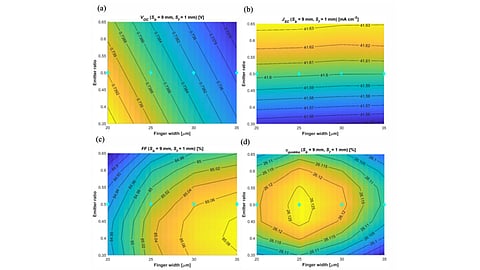
The study, titled Grid Optimization of Tunnel Oxide Passivated Back Contact Silicon Solar Cells, outlines 2 industrialization pathways: improving efficiency through advanced passivation layer design and reducing silver usage via a busbar-less (0BB) electrode structure. It also presents a grid optimization method based on ray-tracing simulations, showing how parameters such as grid spacing and contact design affect performance. The findings indicate that a busbar-less structure can further enhance TBC cell efficiency.
DAS Solar said its DBC 3.0 cell technology has reached a conversion efficiency of 27.77%, with the research providing a basis for further development toward DBC 4.0.
In February, DAS Solar, in collaboration with UNSW and Xiamen University, published a research paper proposing a novel method for testing hot-spot characteristics in TBC modules that combines laboratory testing, theoretical modeling, and outdoor power station validation (see China Solar PV News Snippets).
PV paste manufacturer DKEM has announced a private placement plan to raise up to RMB 3 billion from no more than 35 investors.
Of this, RMB 354 million will be allocated to 2 PV silver paste projects, including a 2,000-ton low-silver-content paste manufacturing facility targeting TOPCon silver-copper and nickel-based metallization products. Another plant will focus on next-generation PV metallization technologies, including ultra-fine line, space-grade, and copper-based pastes. The company said these facilities aim to mitigate the impact of volatile silver prices.
The company plans to use the remaining funds to support the expansion of electronic-grade metal powder capacity, a semiconductor packaging and testing base, an R&D center, and working capital and debt repayment.
Recently, DKEM subsidiary Solamet signed a global patent licensing agreement with an undisclosed counterparty for thick-film paste technologies containing lead oxide and tellurium oxide (see China Solar PV News Snippets).
PV encapsulant manufacturer Hangzhou First has received a Level 1 energy efficiency certification from the National Center for Quality Supervision and Inspection of Photovoltaic Products (CPVT) for its Linkermen butyl rubber sealant.
The certification evaluates module efficiency and environmental durability in accordance with the relevant technical standard. The company said the product offers strong insulation, high barrier performance, and stable adhesion, and is already in mass production for high-efficiency modules, including heterojunction, perovskite, and thin-film technologies.
Solar industry analytics agency InfoLink Consulting reported that Hangzhou First, SVECK, and Betterial remained the top 3 global PV encapsulant film suppliers by shipment volume in 2025.
With global module output estimated at 646 GW, the 3 companies are expected to account for more than 65% of total encapsulant film supply, reflecting a concentrated competitive landscape.
The report noted that rising trade barriers, including India’s anti-dumping investigations into EVA and POE/EPE films, are increasing the importance of overseas expansion. Betterial’s investments in Indonesia and Türkiye were highlighted as measures to support international shipments and mitigate policy risks.
PV and lithium battery equipment manufacturer Autowell reported 2025 revenue of RMB 6.397 billion, down 30.60% year-on-year (YoY), while adjusted net profit fell 66.69% to RMB 406.96 million. These figures are at the low end of the company’s forecast in January of RMB 6.39 billion and RMB 6.74 billion for revenues and RMB 394 million and RMB 534 million for net profit (see China Solar PV News Snippets).
The company attributed the decline to the slowdown in the PV industry and capacity adjustments among customers, which extended equipment acceptance cycles and reduced revenue recognition.
Its PV equipment segment revenue dropped 42.81% to RMB 4.443 billion. In contrast, lithium battery and energy storage equipment revenue rose 19.04% to RMB 547.17 million, while semiconductor equipment revenue increased 217.02% to RMB 146 million, partially offsetting the overall decline.
