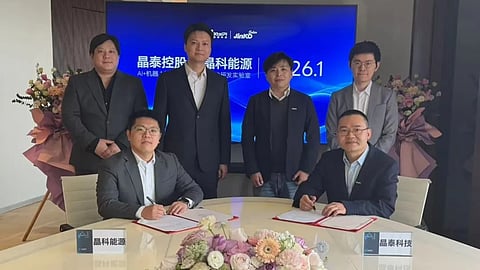


Leading PV and ESS manufacturer JinkoSolar has announced a strategic cooperation agreement with XtalPi, an AI- and robotics-enabled R&D innovation platform, to establish a joint venture focused on high-throughput R&D of perovskite tandem solar cells using AI technologies.
The collaboration combines JinkoSolar’s accumulated expertise in PV R&D with XtalPi’s strengths in quantum physics-based algorithms and AI predictive modeling. As part of the agreement, the 2 parties will jointly build what they describe as the ‘world’s first’ fully closed-loop perovskite-silicon tandem experimental line integrating ‘AI decision-making, robotic execution, and data feedback.’ The pilot line will focus on developing perovskite tandem solar cells with higher efficiency and enhanced stability.
JinkoSolar recently obtained dual international certifications issued by BSI: ISO/IEC 27001 for Information Security Management Systems and ISO/IEC 27701 for Privacy Information Management Systems (see China Solar PV News Snippets).
Haier Energy, the new energy arm of global home appliance giant Haier Group, has recently completed its IPO tutoring filing. The company was established in May 2022 and currently has a registered capital of RMB 337 million.
Positioned as a provider of distributed intelligent new energy solutions, Haier Energy focuses on the green energy, energy storage, and intelligent energy controller segments. In July 2024, the company broke ground on a new energy industrial internet eco-park in Qingdao, Shandong Province, with a total investment of RMB 6 billion. Phase I of the project entered trial production in October 2025, with manufacturing focused on PV inverters, energy storage converters, scenario-based products, and balcony PV systems.
In September, Huasun Energy and Haier Energy began discussions to collaborate on the development of integrated photovoltaics (see China Solar PV News Snippets).
DintoSolar, a subsidiary of State Power Investment Corporation (SPIC), has announced plans to invest RMB 300 million in Suining, Sichuan Province, to build a crystalline silicon copper-grid heterojunction (HJT) R&D and pilot platform.
The project will include a 600 MW pilot line for copper-grid HJT cells and modules, as well as a national-level module testing laboratory. Its pilot products will include high-efficiency crystalline silicon copper-grid HJT cells, with a rated output of 5.4 W per cell and an annual capacity of 110 million cells, as well as modules rated at 700 W per unit with an annual output of approximately 857,000 modules.
PV equipment manufacturer Autowell has released its FY2025 earnings forecast, projecting a significant year-over-year (YoY) decline in both revenue and profitability. The company expects 2025 operating revenue to range between RMB 6.39 billion and RMB 6.74 billion, representing a decline of 26.71% to 30.50% from FY2024.
Adjusted net profit is forecast to range between RMB 394 million and RMB 534 million, down 56.84% to 68.20% YoY. Autowell attributed the downturn primarily to cyclical weakness in the PV industry, noting that its PV equipment business continued to contract in 2025 with no clear signs of recovery.
Autowell released its Q3 2025 financial results in November, reporting a 48.65% YoY decline in revenues and an 87.22% decline in net profits (see China Solar PV News Snippets).
Autowell will be one of the companies participating in the TaiyangNews Solar Technology Conference India 2026 (STC.I 2026). To be held on February 5 and 6 in Aerocity, New Delhi, this 2nd edition of the TaiyangNews physical conference will also have banks, investors, and policymakers in attendance. Register for the event here.
The Shanxi Provincial Energy Administration has released an implementation plan to promote the orderly development of green power direct-supply projects, including solar, wind, and biomass.
The plan categorizes projects into grid-connected and off-grid models. For grid-connected projects, the ‘load-driven generation’ principle must be strictly followed. Annual self-consumed renewable electricity must account for no less than 60% of total available generation and at least 30% of the user’s total electricity consumption, with the share to increase gradually to a minimum of 35% by 2030. Any electricity exported to the grid beyond self-consumption must fully participate in market trading and will not be eligible for the mechanism tariff scheme.
