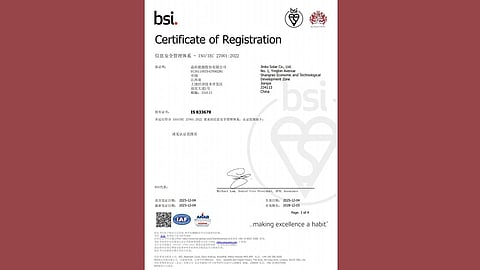


Integrated solar PV manufacturer JinkoSolar has obtained dual international certifications issued by British Standards Institution (BSI): ISO/IEC 27001 for Information Security Management Systems and ISO/IEC 27701 for Privacy Information Management Systems. The former is a globally recognized standard covering the full lifecycle of information security risk identification, control, and continuous improvement, while the latter builds on ISO/IEC 27001 by strengthening management requirements across the lifecycle of personal data and privacy information.
At the recent TaiyangNews Solar & Sustainability conference, JinkoSolar’s Head of Sustainability Development, Lin Sun, outlined the company’s sustainability systems, certification progress, and contributions to sector-wide financial reforms (see ESG, Traceability Efforts, & Bankability Insights By JinkoSolar).
The 1 GW offshore photovoltaic project in Kenli District, Dongying, Shandong Province, developed and invested by CHN Energy Group, has achieved full-capacity grid connection and commenced power generation. According to CCTV, the project is said to be China’s first gigawatt-scale offshore PV plant and the world’s largest open-sea offshore PV project currently.
The project occupies 1,223 hectares of sea and, for the first time, uses a 66 kV offshore cable in combination with an onshore cable transmission solution, enabling higher transmission capacity and lower overall costs. Annual power generation is expected to reach about 1.78 billion kWh, sufficient to meet around 60% of Kenli District’s total electricity demand.
In November 2025, the ‘Zhonglu Island Modern Marine Ranch Complex,’ developed by Jingneng International, featuring 200 MW wind and 200 MW offshore PV, received approval from Yuhuan City (see China Solar PV News Snippets).
China’s National Development and Reform Commission (NDRC) and the National Energy Administration (NEA) have jointly released a policy guidance document to promote high-quality power grid development. The document provides guidance on grid planning, power system design, technological development, and grid governance to support the large-scale, high-proportion development of renewable energy over the medium- to long-term.
According to the document, by 2030 China aims to expand ‘west-to-east power transmission’ capacity to more than 420 GW, add around 40 GW of new interprovincial power mutual-support capacity, support renewables accounting for about 30% of total power generation, enable the grid to accommodate up to 900 GW of distributed renewable energy, and support more than 40 million charging facilities nationwide.
The Shandong Provincial Development and Reform Commission has approved the implementation plan for a green power direct-supply project for the green manufacturing base of Dongying Times New Energy Technology Co., Ltd., the province’s first such project.
Under the plan, the company will build a 40 GWh lithium battery cell green manufacturing base in Dongying, with annual electricity consumption of 500 million kWh. On the power supply side, a total of 345 MW of renewable energy capacity will be constructed, including 75 MW of wind power and 270 MW of solar PV, along with a 300 MW/1,200 MWh energy storage system. The project is scheduled to achieve synchronized commissioning across generation, grid, load, and storage by the end of 2026, providing green power traceability for lithium-ion battery exports.
Energy developer China Huaneng has issued a tender notice for the procurement of its 2026 inverter framework agreement. The tender covers a total of 10 GW of inverters for future solar PV power projects under the Group, with the framework agreement valid for 1 year.
The procurement is divided into 3 lots: 1 GW of centralized inverters with single-unit power ratings of 3.125 MW and above (1,500 V DC); 6 GW of string inverters in the 300 kW-400 kW power range; and 3 GW of string inverters with power ratings of 400 kW and above. Bid opening is expected in late January.
