
- Markets
- Business
- People
- Opinion
- Technology
- Storage+
- Reports
- Our Events
- Tenders
- Price Index
- Top Modules
- ServicesServices
- AnalysisAnalysis

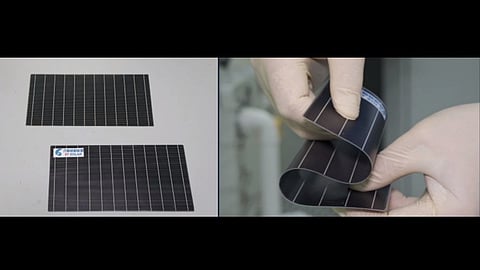
China’s Tianzhou-10 cargo spacecraft is carrying flexible encapsulated monocrystalline silicon solar cell samples for space exposure testing. The samples will be installed on the external exposure platform of China’s space station material cabin and tested under extreme space conditions, including particle radiation, ultraviolet radiation, and atomic oxygen erosion.
The flexible cells were developed by the Shanghai Institute of Microsystem and Information Technology (SIMIT) under the Chinese Academy of Sciences. According to the institute, the cells offer advantages over conventional gallium arsenide (GaAs) space cells due to their lightweight, rollable structure, with weight kept below 1 kg/m² and costs reduced to around 1/10th of those of GaAs cells.
The project is expected to support China’s commercial space internet constellation, in-space computing, and future space PV development.
Leading PV manufacturer JA Solar plans to establish a future energy venture fund with Shanghai Shenergy Chengyi Private Equity Fund Management, part of Shenergy Group, with a committed capital of up to RMB 1 billion.
JA Solar will participate as a limited partner with a planned contribution of up to RMB 300 million. The fund will have a maximum duration of 12 years.
According to JA Solar, the fund will focus on future energy projects with technological and commercial potential, aligned with the company’s strengths in utility-scale PV and smart energy technologies.
Shenergy recently issued a tender to procure 1 GW of high-efficiency PV modules for its 2026-2027 projects (see China Solar PV News Snippets).
Perovskite developer Aolian Solar has completed its first perovskite PV power generation test project. Aolian Solar is a subsidiary of automotive electronics and electrical components manufacturer Nanjing Aolian AE&EA Co., Ltd. (ALAE).
The 15 kW project spans more than 1,200 m² and integrates crystalline silicon, perovskite, and cadmium telluride PV technologies. The facility uses 5G-based intelligent monitoring systems to track generation performance under multiple operating scenarios.
The company said the project will be used to compare generation data across different PV technologies and evaluate their suitability for various applications.
In December 2025, Aolian Solar’s 60 cm × 60 cm perovskite cell achieved a TÜV NORD-certified efficiency of 19.77%.
Sichuan Province has released trial implementation rules for direct green power supply projects, requiring that renewable electricity be prioritized for local consumption.
Under the new rules, projects must achieve annual self-consumption rates of at least 60% of total available generation and at least 30% of total electricity consumption, with this target increasing to 35% by 2030.
For grid-connected projects, surplus power exported to the grid must not exceed 10% in Aba, Garzê, Liangshan, and Panzhihua, and 20% in other regions.
The rules also require project electricity consumption to participate directly in market transactions.
Earlier this year, Guangxi mandated a similar ≥60% self-consumption target for green power direct-supply projects in the province (see China Solar PV News Snippets).
China’s Ministry of Industry and Information Technology (MIIT) has launched its 2026 industrial energy conservation and enforcement program, expanding inspections across PV, wind, and battery manufacturing supply chains.
The program covers PV modules, wind turbine generators, power batteries, energy storage batteries, and hydrogen production equipment. Inspections will focus on energy consumption during raw material production, manufacturing, and final assembly processes.
MIIT said the initiative is intended to strengthen lifecycle energy management and support industrial carbon reduction targets.
