
- Markets
- Business
- People
- Opinion
- Technology
- Storage+
- Reports
- Our Events
- Tenders
- Price Index
- Top Modules
- ServicesServices
- AnalysisAnalysis

Key takeaways:
SPT, RCT Solutions, and GCL highlighted how energy costs and plant scale are becoming central to polysilicon competitiveness
Advanced purification and reactor technologies are improving material quality while reducing power consumption
GCL’s FBR-based granular polysilicon process operates at lower temperatures, reducing both energy use and carbon intensity
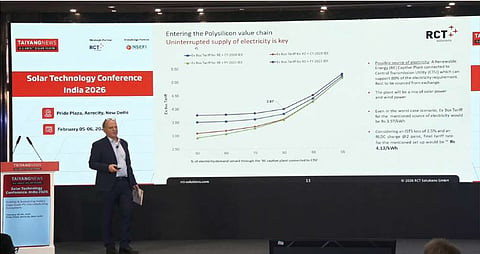
An important shift at the beginning stage of the solar value chain – polysilicon – is that energy has effectively become a defining technology parameter. Power is identified as the largest cost component, with competitive polysilicon production requiring electricity prices in the range of $0.04 to $0.06/kWh, according to Silicon Products Technology (SPT), an engineering, consulting, and technology transfer company in the polysilicon area. RCT Solutions, which provides end-to-end solutions for setting up solar fabs across the value chain, illustrated its case for India as a renewable-linked captive power approach delivering electricity at approximately INR 4.13/kWh, with around 80% of demand met through renewable sources. At the same time, scale is being redefined, with recommendations pointing toward plant capacities exceeding 25,000 tons per year to achieve meaningful economies of scale while maintaining high material quality.
At the process level, polysilicon manufacturing is evolving toward higher integration and efficiency. Technologies such as chlorosilane purification systems are enabling boron levels below 10 ppt. Improved reactor designs, including silver-plated bell-jar CVD systems, deliver more than a 50% reduction in power consumption, along with higher deposition rates and improved cleanliness. These developments indicate a broader shift toward semiconductor-like process discipline in solar-grade polysilicon.
As part of discussions for the TaiyangNews Cell & Module Technology Trends 2026 report, GCL shared updates on its proprietary FBR-based granular polysilicon. This process enables silane pyrolysis with conversion efficiencies above 90%. The major advantage of the approach is its low operating temperature at approximately 700°C. This results in about a 50% reduction in total energy consumption and a reduction in carbon intensity from roughly 57 kg CO₂ per kg of silicon to around 14 kg CO₂ per kg of silicon, according to GCL. At the reactor level, unit capacities exceed 5,000 tons per year with continuous operating cycles exceeding 200 days, while a modular plant design has enabled GCL to scale to approximately 480,000 tons per year of installed capacity (see Upstream Solar Manufacturing Under Spotlight).
The text is an edited excerpt from TaiyangNews’ latest report on Cell & Module Technologies Trends 2026, which can be downloaded for free here.
