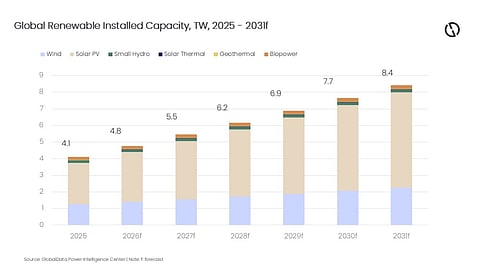


GlobalData forecasts global installed renewable capacity to expand from 4.1 TW in 2025 to 8.4 TW by 2031, representing a 13% CAGR
It will be driven largely by the scalability of solar PV and supportive policies
Solar PV became the largest renewable capacity source in 2025, accounting for 56.1% of total installed capacity, ahead of wind at 33.5% and biopower at 5.3%
Global solar generation reached around 2,800 TWh, with China contributing about 1,150 TWh or around 41%, followed by the US and India
Rising electricity demand from AI, data centers, hydrogen production and electrification will support renewable growth
Policy changes in the US could create a ‘two-speed’ global expansion, while China continues to accelerate clean-energy investment
GlobalData forecasts the world’s total installed renewable capacity to grow from 4.1 TW in 2025 to 8.4 TW by 2031, representing a 13% compound annual growth rate (CAGR). This will be driven by the high scalability of solar PV, supported by falling costs and stronger policy support.
Solar PV is already the largest source of renewable electricity generation globally, having surpassed wind last year, as it accounted for roughly 56.1% of the total installed capacity in 2025. Wind accounted for 33.5%, followed by biopower at 5.3% among other sources.
In terms of power generation, solar PV likely produced 2,800 TWh while wind generated 2,770 TWh, analysts estimate. China alone generated about 1,150 TWh of solar electricity, accounting for around 41% of global PV output. The US generated 486 TWh and India 189 TWh.
Both solar PV and wind will continue to dominate the mix going forward as electricity demand rises with hydrogen production, growth of AI and data centers, and electrification picks up pace. Even within the renewable energy industry, the use of AI is gaining traction.
“By enabling real-time balancing of supply and demand, AI reduces curtailment and operating costs while reinforcing overall grid resilience. Industry leaders such as Vestas, ENERCON, JinkoSolar, and First Solar are deploying AI at scale to boost operational performance, lower costs, and strengthen asset reliability,” said GlobalData Power Analyst Rehaan Aleem Shiledar.
Technology firms are especially increasing investments in clean power for their data centers and to back their decarbonization targets. The names include Meta, Amazon, and Google, among others (see Google Enters $20 Billion RE Partnership To Run US Data Centers).
Geographically, China will be in the driver’s seat as it presses ahead with solar PV deployment driven by its carbon-neutrality objectives, economies of scale, and sharp cost reductions.
Nonetheless, on the policy side, GlobalData believes that there could be a ‘two-speed’ expansion of renewable energy. In the US, policy shifts under Donald Trump may weaken federal support for renewables, potentially slowing deployment.
However, global growth is expected to continue, supported by declining technology costs, strong corporate demand, and supportive policies in other markets. At the same time, China’s clean energy sector is accelerating, with the industry accounting for more than 90% of incremental investment growth in 2025 and contributing over one-third of the country’s economic expansion.
