

Nextpower reports record Q1 FY27 quarterly revenue and backlog supported by continued customer demand
The company completed the acquisition of Zigor’s power conversion business and is offering UL-certified utility-scale inverters in the US
It has raised the lower end of its FY2027 financial guidance after reporting record backlog of over $5.5 billion
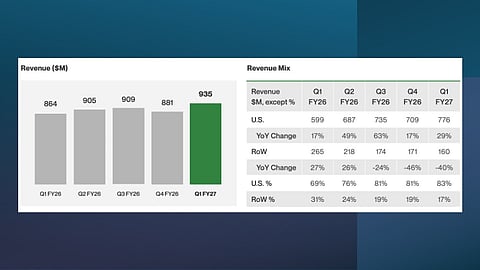
With $935 million, US-based integrated energy technology company Nextpower, previously Nextracker, says it has achieved record financial results for Q1 FY27 (ended July 3, 2026). The 8% year-on-year (YoY) increase in revenue was driven by its solar tracker system sales business.
The US market was its stronghold, contributing 83% of total revenue, followed by 17% from the rest of the world.
Nextpower’s GAAP net income increased to $165 million, compared with $157 million a year earlier and $151 million in the previous quarter. Its adjusted EBITDA for the reporting quarter grew 8% YoY to $233 million, while GAAP gross profit went up from $282 million in Q1 FY26 to $336 million in Q1 FY27.
The company said its backlog at the end of the period exceeded $5.5 billion, supported by bookings across its tracker business and complementary technologies. It added that the recently closed acquisition of Prevalon contributed an incremental backlog of more than $300 million. Its acquisition also marked the company’s entry into the battery energy storage business (see Nextpower Ventures Into Battery Energy Storage Business).
Nextpower also expanded its clean power technology platform with the acquisition of Zigor Corporation’s power conversion business, along with the latter’s US-based subsidiary Apex Power. With this, its portfolio now also comprises UL-certified central inverters for utility-scale solar and energy storage projects in the US and IEC-certified products for Europe and the rest of the world, as it closed the deal on July 30, 2026. The company said its utility-scale central inverters are now commercially available in the US with UL certification.
It expects deliveries from its expanding US manufacturing operations to begin in early 2027, with more than 10 GW of manufacturing capacity planned within the following 12 months.
Nextpower’s expansion into inverter space follows the US government banning the import of new foreign-produced power inverters citing national security and cybersecurity concerns (see US FCC Tightens Rules On Foreign Power Inverters).
“Our entry into power conversion technology represents a natural extension of Nextpower’s platform, particularly in light of our Prevalon energy storage acquisition,” explained Nextpower. “Not only do these technologies expand our existing product portfolio, they position the company at the nerve center of the modern grid, enabling customer value creation across key grid interconnection nodes and system control strategies.”
“These results confirm that customers are responding positively to our expanding clean power technology platform, including strong adoption of eBOS and growing traction across the broader product portfolio,” added Nextpower CEO and Founder Dan Shugar.
Nevertheless, analysts at TD Cowen noted that higher freight and logistics costs, partly due to a shortage of truck drivers following stricter enforcement of English-language proficiency requirements in the US, weighed on Nextpower's margins late in the quarter and contributed to modest shipment delays. “This is an issue that investors will likely need to monitor for freight-intensive industries in 3Q,” according to the analysts.
Nextpower is also set to acquire Europe’s Zimmermann PV-Steel Group, bringing fixed-tilt systems, floating PV systems, AgriPV systems, high-density 1P trackers, and wire management solutions into its fold. The deal, once complete, will expand its European presence and product portfolio, extending its reach into 15 additional countries (see Nextpower To Acquire Zimmermann In Up To €330M Deal).
For fiscal year 2027, Nextpower has raised the lower end of its revenue guidance to $4.1 billion to $4.4 billion, from the previous range of $4.0 billion to $4.4 billion. It has also increased the lower end of its GAAP net income forecast to $540 million, from $507 million, and raised the lower end of adjusted EBITDA guidance to $870 million, from $845 million.
