

North America saw higher solar and wind PPA prices in Q1 2026, driven by tight supply, strong demand, says LevelTen Energy
Europe recorded continued declines in solar and modest wind price movement, influenced by weaker demand and growing use of hybrid contract structures
Both the markets show a clear divergence, with rising volatility in North America and more flexible contracting trends shaping Europe
Solar power purchase agreement (PPA) prices in Q1 2026, as evaluated by LevelTen Energy, show diverging trends across major markets, with North America recording an increase driven by tighter supply conditions and strong demand from large power users. Meanwhile, Europe continues to see a gradual decline in prices amid softer demand and evolving contract structures.
North America
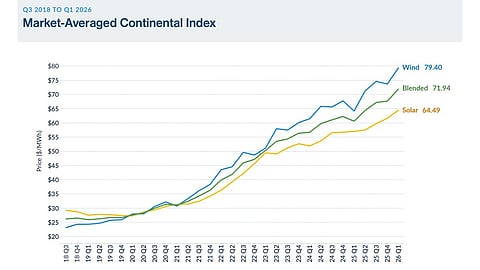
Solar PPA prices during Q1 2026 in the US rose by 4.6% quarter-on-quarter (QoQ) and by over 13% on a year-on-year (YoY) basis, says LevelTen Energy.
This increase to $64.49/MWh was mostly driven by an overall rise in market-averaged PPA prices in the California Independent System Operator (CAISO) region, says LevelTen Energy in its Q1 2026 PPA Price Index North America report. It determines P25 (25th percentile) prices for each market (North America and Europe) by technology type. This report analyzed data on 291 price offers from 207 renewable energy projects in 6 Independent System Operators (ISO) across the US and Canada.
Solar project developers have been navigating clean energy tax cuts under the One Big Beautiful Bill Act (OBBBA) with ‘strategic poise’, according to the analysts. They have been able to preserve tax credit access for a meaningful portion of their pipelines through rigorous development work.
Yet, they continue to face challenges stemming from tariffs, rising insurance costs, labor shortages, and federal-level permitting bottlenecks.
Despite the price rise, LevelTen Energy analysts state that buyers continue to pursue clean electricity and clean energy attributes from wherever they can be sourced, owing to high data center-driven demand for electricity.
Wind energy prices also rose nearly 8% QoQ and close to 24% YoY to $79.40/MWh with intense scrutiny and lengthy bottlenecks around permitting.
The war in Iran may have pushed global oil prices higher, increasing fuel costs for consumers, but the US natural gas prices have remained mostly stable, keeping electricity prices largely unchanged for now. Regulators and utilities are closely examining the impact of rising power demand from large users like data centers.
“Savvy data center developers are staying on top of these evolving requirements, with the most successful ones proactively bringing their own power and capacity through a variety of resources — including renewables,” observe the analysts.
The PPA market is split in the region, the report points out. Big companies are ‘hastily’ buying large volumes of clean energy, but many others are waiting because prices are rising and the Greenhouse Gas Protocol (GHGP) rules may change. These rules related to Scope 2 standards are expected to be implemented in 2028 (see Solar PPA Prices Move In Opposite Directions In North America & Europe).
At the same time, ISOs are changing power market rules to ensure system reliability across different regions. To handle this, smarter buyers are using a mix of clean energy sources, like solar, wind, and storage, to get reliable power and start operations faster.
Europe
Compared to the US, Europe is a different story as P25 PPA prices for both solar and wind energy continue to decline. LevelTen Energy assessed data on 51 price offers from 41 renewable energy projects in 11 European nations in its Q1 2026 PPA Price Index Europe report.
For solar, the €55.05/MWh price was the 4th consecutive quarter of decline. In Q1 2026, the prices dropped by 4% QoQ and close to 13% YoY. Analysts attribute the price decline to ‘tepid’ demand for renewable PPAs.
They opine, “Negative prices and solar price cannibalisation are making buyers wary, and development continues to go hybrid across many European geographies.”
Although adding storage significantly improves project economics, especially for solar, LevelTen analysts believe buyers are still signing deals for standalone solar assets even as they use a wider range of contract types to manage risks like negative pricing.
For wind energy, the decline was less pronounced at less than 1% QoQ, at €85.38/MWh.
With Gulf energy supplies to Europe disrupted due to the Middle East crisis, natural gas prices have spiked. Damaged energy infrastructure may also have long-lasting impacts. While the conflict underscores risks of fossil fuel dependency, LevelTen says this is prompting several nations to shift away from fossil fuels towards renewable-powered energy systems (see UK Turns To Plug-In Solar Amid Middle East Crisis).
European companies are under pressure from rising costs and energy price volatility driven by global tensions. This is renewing interest in renewable PPAs as a hedge, as they capitalize on falling PPA prices and flexible contract structures, including storage-backed projects.
Both these reports can be purchased on LevelTen Energy’s website.
