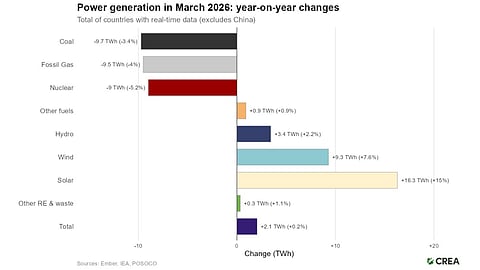


Solar and wind expansion led to a 1% YoY decline in fossil fuel power generation in reporting countries in March 2026, the 1st month of Strait of Hormuz closure
Gas-fired generation fell sharply, while coal output remained largely stable, showing no clear shift back to coal, according to CREA
Strong growth in solar (+14%) and wind (+8%) continues to reshape the global energy mix and improve resilience, according to the analysts
The expansion of solar and wind energy helped limit the impact of the Strait of Hormuz closure on global power systems, contributing to a decline in fossil fuel-based generation. The shift, says the Centre for Research on Energy and Clean Air (CREA), underscores the rising importance of renewables in the global energy mix.
The CREA analysis, based on countries reporting near-real-time data, shows that fossil-fuel power generation declined by 1% year-on-year (YoY) in the countries covered.
This decline was most visible in gas-fired output, that fell 4% year-on-year (YoY) in March 2026 which was the 1st month of Hormuz closure. Coal-fired generation remained stable overall, indicating no significant shift back to coal despite tighter fuel markets.
Outside China, coal and gas generation both declined by 3.5% and 4% respectively, supported by a rise in solar and wind output. Hydropower generation increased slightly by 2%, although this was partly offset by lower nuclear output.
This decline was offset by 14% increase in solar, and 8% in wind power generation. With 510 GW of solar and 160 GW of wind energy deployment in 2025, the world has around 1,100 TWh annual capacity that’s nearly double the power that could be produced from LNG volumes transported through the Strait of Hormuz before its closure, claims CREA (see IRENA: Global Solar PV Additions Exceeded 510 GW In 2025).
This shows that the rapid growth of clean energy is reshaping the global power system, it adds.
In the US and India, solar power was the single largest driver of the fall in fossil power generation, while it was wind energy in the Netherlands and Germany. Improved operation of nuclear energy and hydropower helped South Africa and Turkiye. Japan and South Korea saw a significant increase in coal-fired power generation during the month.
Going forward, CREA analysts anticipate high fossil fuel prices to speed up the adoption of clean energy technologies such as solar, electric vehicles (EV) and heat pumps. This will mostly be a result of direct consumer demand rather than slower government or utility actions.
“There is, however, no shortage of announcements of clean energy policies and investments from governments and utilities in response to the crisis. They have not gotten the same spotlight as statements on coal which have fed a non-factual narrative of a “coal comeback,” argues CREA.
It shares a number of renewable energy-focused announcements in the recent weeks across various countries, including Indonesia accelerating the roll out of 13 GW out of 100 GW solar vision, with the formation of a task force, and UK’s plans to boost solar and heat pumps (see Indonesia Secures $1.4 Billion For 50 GW Solar Manufacturing and UK To Ensure Plug-In Solar Panels In Shops ‘Within Months').
