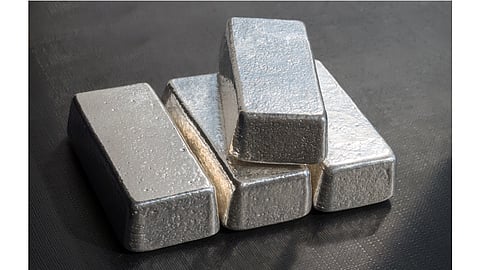


Silver spot prices exceeded $110/oz on January 27, 2026, a steep rise from annual averages of $40.11/oz in 2025, $28.46/oz in 2024, and $23.35/oz in 2023
Ongoing demand-supply imbalances are being reinforced by geopolitical tensions, investor concerns over tariffs, and China’s export licensing rules
As solar PV remains one of the largest consumers of silver, major manufacturers are accelerating the shift toward copper-based metallization
Precious metal silver is becoming even more precious as its spot price rises steeply, having exceeded a record high of $110/oz on January 27, 2026.
This is an enormous increase over its average price, reaching $40.11/oz in 2025, $28.46/oz in 2024, and $23.35/oz in 2023 (see Solar PV Industry’s Silver Demand Exceeding Expectations).
While the mismatch between demand and physical supply remains one of the key drivers of the increase in silver prices, in recent times, geopolitical tensions and investor concerns about tariffs, mainly driven by the uncertainty around US policy, are also contributing to this increase.
Additionally, China’s silver export licensing rules, which came into effect on January 1, 2026, are contributing to the price rise. These rules require companies to seek government approval to export some silver products while ensuring priority for domestic use. This is likely tightening global supply, leading to higher prices. While the licensing regime has been in place since 2019, it has been extended to remain in effect till 2027.
At the same time, a weakening USD and skyrocketing gold spot prices (exceeding $5,000/oz on January 26, 2026) are also driving up silver prices as an alternate investment.
One of the largest demand drivers for silver is the solar PV industry, since silver paste serves as the electrical conductor in solar cells. It is used in the manufacture of several high-efficiency cell technologies. The solar industry has been exploring innovative ways to reduce the use of silver by replacing it with copper.
Speaking at the 2025 TaiyangNews Virtual Conference on Cell & Module Production Equipment & Processing Materials, ITRPV’s Markus Fischer said that the industry can reduce the use of silver by transitioning towards copper-based metallization, including silver-coated copper, and in the future, pure copper (see ITRPV Outlines Key PV Technology & Market Trends).
Among the largest solar PV manufacturers globally, JinkoSolar and LONGi have announced plans to substitute base metals for silver in their solar cells following the sharp rise in the cost of silver, pushing up production costs (see LONGi Expects Up To RMB 6.5 Billion Net Loss In 2025).
SPIC and AIKO are among other leading suppliers working on copper-based metallization (see Metallization In BC Solar Cells: Status & Outlook).
Speaking about the impact of silver costs while sharing its financial results with analysts, Indian manufacturer Emmvee said it has lowered silver consumption by more than 50% to 60% over the last 3-4 months, thereby reducing its impacts on costs to a negligible level. It expects another 40% reduction going forward.
Emmvee CMO Narayanaswamy Devendiran is joining the TaiyangNews Solar Technology Conference India 2026 (STC.I 2026), on February 5 and 6 in Aerocity, New Delhi. This 2nd edition of the TaiyangNews physical conference will also have banks, investors, and policymakers in attendance. Register for the event here.
