

TOYO has completed its Humble, Texas, expansion, raising the factory’s annual production capacity to 2 GW
It plans to add a 1.5 GW HJT cell line at the Texas site by Q1 2028 with a $357 million investment
TOYO is also evaluating cell technology for potential space applications
Japanese solar PV manufacturer TOYO has completed the expansion of its US solar module manufacturing facility in Humble, Texas. This expansion has raised the plant’s annual nameplate capacity to 2 GW. Phase I of the module line started operations in October 2025.
The company has secured close to $240 million in binding US solar module supply agreements through H1 2027, since mid-June 2026. Deliveries are already underway. The contracts cover utility-scale, commercial & industrial, and community solar and data center applications, claims the manufacturer.
TOYO acquired the Texas industrial facility from Solar Plus Technology in November 2024, with capacity to host 2.5 GW of module production. Back then, it had unveiled plans to expand the plant to 6.5 GW by 2029 (see TOYO Solar Buying 2.5 GW Texas Module Manufacturing Fab).
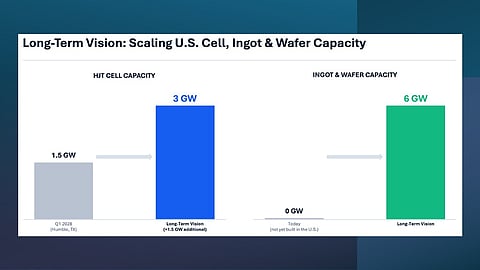
It plans to add a 1.5 GW heterojunction (HJT) cell production line at the site, with completion expected in Q1 2028. The company will build it with a $357 million investment. The fab will mark its foray into US solar cell production (see TOYO Announces 1.5 GW US HJT Solar Cell Factory).
This expansion is aligned with the company’s strategy to build a vertically integrated US manufacturing platform. In the long run, it aims to operate 3 GW of HJT cell production and 6 GW of ingot and wafer manufacturing capacity in the US.
Currently, TOYO operates a 4 GW solar cell factory in Ethiopia, and another 2 GW in Vietnam. Speaking at its Analyst Day, TOYO said its Ethiopian cell production uses wafers made in Indonesia and plans to shift to US-made wafers. The company said it does not use Chinese-origin wafers in its Ethiopian cells, and that its polysilicon supply is entirely non-Chinese, with about 70% sourced from the US.
TOYO is seeking clarification from the US Department of Commerce (DOC) that cells produced in Ethiopia using non-Chinese wafers and US-origin polysilicon should fall outside the scope of the circumvention inquiry.
TOYO was referring to the DOC’s circumvention inquiry into solar cells and modules from Ethiopia, which followed a petition by the Alliance for American Solar Manufacturing and Trade (AASMT) alleging the use of Chinese-origin wafers in Ethiopian production.
TOYO also said its near-term outlook remains affected by US trade and regulatory uncertainty, including a Section 232 investigation that addresses imports of polysilicon and downstream solar products. It has not provided specific H2 2026 revenue or net-income guidance, but expects to remain EBITDA-positive.
In its Analyst Day presentation, TOYO said it is conducting early-stage evaluation of ‘space-qualified’ solar cells, including HJT and HJT-perovskite tandem technologies. Its analysis shows potential for higher efficiency and radiation resistance, but the company said the technology remains at the R&D stage and is not yet a commercial business line.
