

Vikram Solar added approximately 1.7 GW of orders during Q2 FY27, taking its total order book to 8.2 GW
The company says DCR and distribution sales gained a larger share of its quarterly business mix
It is preparing to commission its 9 GW TOPCon cell facility and enter battery storage and battery cell manufacturing
Vikram Solar reported a sharp decline in its profitability for Q2 FY27 (ended September 30, 2026), as lower sales volumes and pricing pressure weighed on its financial performance.
The Indian solar module manufacturer, however, saw stronger order inflows and an improved contribution from domestic content requirement (DCR) modules and distribution sales.
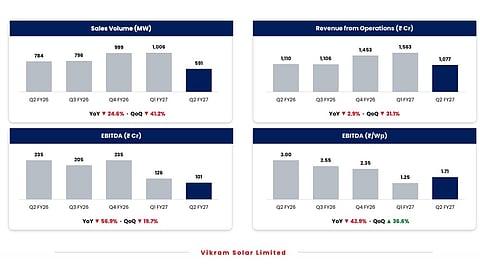
During the reporting quarter, Vikram Solar reported consolidated revenue from operations of INR 1,077 crore, down 2.9% year-on-year (YoY), and 31.1% quarter-on-quarter (QoQ). Sales volume declined 24.6% YoY to 591 MW, compared with 784 MW in Q2 FY26. On a quarterly basis, this was a decline of 41.2%.
Its EBITDA fell 56.9% YoY to INR 101 crore from INR 235 crore a year earlier, while EBITDA margin contracted to 9.4% from 21.2%. Profit after tax (PAT) declined 95.4% to INR 5.9 crore, compared with INR 128 crore in the corresponding quarter last year.
The company attributed the quarterly volume decline partly to seasonal factors, including the monsoon and deferred project execution. It also cited competitive pricing pressure in non-DCR modules and the continued use of externally procured solar cells ahead of its planned cell manufacturing operations.
For H1 FY27, however, Vikram Solar reported revenue of INR 2,641 crore, up 17.7% from INR 2,243 crore in H1 FY26. Sales volume increased 3.1% to 1,596 MW. EBITDA stood at INR 227 crore, down 52.4% YoY.
Despite the quarterly sales decline, Vikram Solar added about 1.7 GW of new orders in Q2 FY27, compared with 0.8 GW in the previous quarter. Its total order book increased to 8.2 GW as of September 30, 2026, from 7.9 GW at the end of June 2026.
The company also reported a shift in its sales mix toward distribution and DCR modules. Distribution and retail accounted for 44% of quarterly sales volume, compared with 14% in Q1 FY27. Distribution sales increased approximately 80% sequentially to 259 MW.
DCR module sales rose 71% quarter over quarter to 130 MW from 76 MW. Their contribution to total sales volume increased to 22% from 7.5% in the previous quarter.
The improved sales mix helped increase EBITDA per Watt by approximately 37% sequentially to INR 1.71/W, despite lower overall volumes.
Vikram Solar is advancing its backward integration plans with a 9 GW n-type TOPCon solar cell manufacturing facility in Gangaikondan, Tamil Nadu. It expects the facility to produce its first cells in December 2026, followed by phased commissioning and trial runs. Commercial production is scheduled to begin in March 2027 (see Vikram Solar To Begin TOPCon Cell Production In December).
It has also secured 1 GW of procured DCR TOPCon cells to meet near-term demand before its own cell manufacturing capacity becomes operational.
Beyond cell manufacturing, Vikram Solar plans to establish 9 GW of ingot and wafer manufacturing capacity at the same site by FY29. This would extend its manufacturing operations from modules to cells, ingots and wafers.
Vikram Solar is also expanding into battery energy storage systems (BESS) through its wholly owned subsidiary, VSL PowerHive, which is establishing a 7.5 GWh annual BESS assembly facility in Oragadam, near Chennai, Tamil Nadu. The facility is scheduled to open in January 2027, with commercial operations expected to begin in April 2027. The company plans to scale the facility's capacity to 15 GWh in subsequent phases. It also intends to enter battery cell manufacturing, with 7.5 GWh of capacity starting in 2028.
Commenting on the results, Gyanesh Chaudhary, chairman and managing director of Vikram Solar, said, “Our focus for H2 is clear: convert executable orders, improve asset utilization, deliver increased DCR volumes and commission the cell project in a disciplined manner.”