

Africa is set for another record year of solar growth, with installations expected to reach 17 GW in 2026, according to a new analysis
Ember and the African Tech Futures Lab see solar adoption spreading rapidly across smaller and emerging markets
Distributed solar is emerging as a major source of new capacity, but limited data is making its growth difficult to track
Africa’s solar market is on track for a third consecutive record year, with the continent expected to install 17 GW of solar capacity in 2026, up 45% from last year, according to a new analysis by Ember.
Unlike several other markets where large-scale solar dominates, Africa’s growth is being driven largely by distributed solar and small-scale systems, according to the Ember analysis, prepared in collaboration with the African Tech Futures Lab.
The analysis uses Chinese export data as an early indicator of installations. Ember says the analysis is based on a new methodology that conservatively estimates around 73% of Chinese solar module exports globally are eventually installed, with an average lag of about six months.
According to the analysis, Chinese solar panel exports to Africa surged in the 12 months through June 2026. During this period, Chinese solar panel exports to Africa surged by 53% year-on-year (YoY) to 23 GW, comparable to Chinese exports to the Middle East (23 GW) and Latin America (25 GW).
Interestingly, the lion’s share of this growth was driven by markets outside of South Africa. In 2023, 52% of Africa’s solar imports went to South Africa, dropping to 20% by June 2026.
In 2025, Africa imported 18.2 GW of solar modules, according to Global Solar Council (see Africa’s Solar Market Accelerates Sharply In 2025, Adding 4.5 GW).
Africa is also steadily expanding its solar panel manufacturing, which the analysts expect to quadruple to around 3.5 GW in 2026, but most of the output will likely be exported, rather than used domestically. While Egypt and Tanzania are leading the new capacity addition, 94% of panels installed in Africa are still imported from China.
The 17 GW expected this year would be the highest annual solar installation total recorded in Africa. The report highlights that this is equivalent to around 100,000 solar panels or 47 MW installed every day. In previous years, solar additions rose 25% in 2024 and a further 51% in 2025, highlighting the market's rapid acceleration.
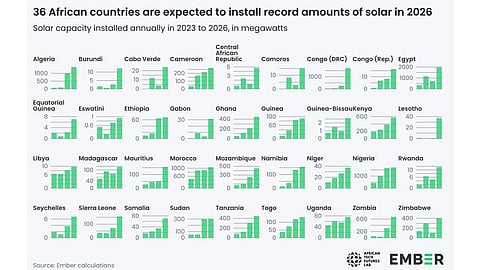
Solar growth is spreading across Africa, with 36 of 54 countries expected to reach record installations in 2026. This year, analysts expect 19 countries to see growth of more than 100%, including a 544% surge in the Democratic Republic of Congo (DRC). They project annual installations of 3.3 GW in South Africa this year, 2 GW in Egypt, 1.7 GW in Nigeria, 1.7 GW in the DRC, 1.4 GW in Algeria, and 1 GW in Morocco. Ember adds a caveat that some landlocked markets may be underestimated because of gaps in trade data.
At least 10 nations will add at least 1 GW of solar between 2023 and 2026. The report emphasizes that the most dramatic expansions are projected in countries with the smallest grid capacity, where solar additions will match or exceed their entire existing national grid.
This 17 GW would add 23 TWh of generation annually, assuming a conservative 15% capacity factor, which the report says will be equivalent to 23% of the continent’s annual electricity generation of 982 TWh in 2024.
Ember says the biggest impact will be felt in countries with some of Africa’s smallest electricity systems. In 10 countries, solar installations in 2026 are expected to add more than 10% to annual grid electricity generation, led by Sierra Leone at 97%, followed by Togo at 24%, and Somalia and Djibouti at 21% each, among others.
Distributed solar is expected to account for most of Africa’s solar growth, but it remains difficult to measure due to the lack of official data reporting. Ember estimates that 75% (20 GW) of the 26 GW of solar added between 2023 and 2025 came from distributed systems, mainly rooftop solar.
Growth could be higher than official figures suggest, as only 12 countries report distributed solar data, and these figures still underestimate the market.
“Across Africa, distributed energy resources are rapidly expanding, and in many cases, overtaking grid capacity. This transition is chaotic and disruptive, and far from the orderly model planned in national strategies. Policymakers need to start responding to this shift,” according to Joel Nana, Research Director, African Tech Futures Lab Project Manager, Sustainable Energy Africa.
Analysts explain Africa’s distributed solar boom as being driven less by subsidies and more by a simple need for cheaper, more reliable power. Businesses have been the early adopters, turning to solar as falling panel prices make the economics increasingly attractive.
However, poor data on distributed solar could lead to wrong decisions on grid, battery, and fossil fuel investments, the report writers caution. “Solar panels have become so cheap, the economics are compelling. But so much of this growth is hidden from view - national governments need to get better at gathering solar data,” stressed Ember Chief Analyst Dave Jones.
Nevertheless, the report highlights that the rapid growth of solar could meet much of Africa’s rising electricity demand while making power cheaper and more accessible. Solar paired with batteries is also increasingly replacing diesel generators. The rapid growth of solar and batteries could help meet rising electricity demand and reduce reliance on diesel generators.
Analysts estimate that a year’s worth of Chinese solar panel imports costs about $2.4 billion, while generating the same amount of electricity with diesel would cost roughly that much every three months.
The complete analysis titled The take-off in African solar that official statistics can't yet see is available on Ember’s website.
