

Tracking the progress toward its 30-30-30 goal in an updated white paper, ARENA says while the country is making progress, overall project costs are a challenge
According to the whitepaper, reducing construction and deployment costs is now as important as improving solar panels
The agency is backing new approaches to speed up utility-scale solar deployment through automation and integrated demonstrations
Australia has made progress toward its ultra-low-cost solar (ULCS) goals, but the next phase will depend less on improving solar panels and more on reducing the cost and complexity of building large-scale projects, according to an updated white paper from the Australian Renewable Energy Agency (ARENA).
The update reviews progress since ARENA released its original ULCS White Paper in 2023, which outlined its 30-30-30 vision for 2030. This refers to 30% solar module efficiency, installed costs of 30 cents/W, and solar electricity costing less than AUD 20/MWh (see ARENA’s 30-30-30 Whitepaper For PV Technology).
ARENA says that while these targets remain unchanged, market conditions and deployment challenges have evolved.
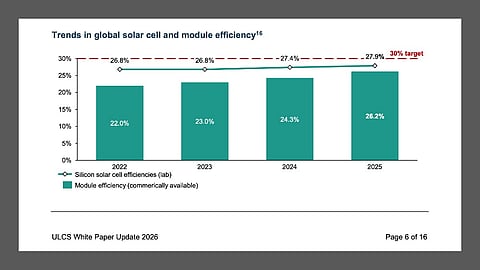
According to the report, laboratory silicon solar cell efficiencies have reached 27.9%, while commercial module efficiencies have improved to 26.2%, moving closer to the 30% target. As per TaiyangNews TOP SOLAR MODULES Listing for July 2026, the highest commercial solar module efficiency stands at 25% (see TOP SOLAR MODULES Listing – July 2026).
Module prices have also remained at historically low levels due to global oversupply.
However, the white paper says overall installed costs and the levelized cost of electricity (LCOE) have not fallen at the same pace. Rising prices for balance-of-system (BOS) components – including labor, civil works and grid connection – along with inflation across various project cost components, have largely offset the savings from cheaper solar modules.
China maintained the lowest installed utility-scale solar costs between 2020 and 2024, reducing them to 95 c/W in 2024. Australia's costs declined to 152 c/W, while the US remained the highest-cost market at 171 c/W. Although costs fell across all three countries over the period, reductions in Australia and the US were relatively modest and largely plateaued in recent years, as per ARENA.
The report also noted that higher rooftop solar penetration has reduced daytime wholesale electricity prices. Investors also increasingly favor solar projects paired with battery storage over standalone utility-scale solar. These trends have made securing revenue for standalone projects more challenging.
“Australia needs a shift in focus towards how solar projects are delivered, not just what is installed,” said Darren Miller, ARENA CEO. “Without a change to the approach in how large-scale solar is built, financed and integrated, we risk missing the opportunity to bring costs down fast enough to support the next phase of the energy transition.”
In response to the changing market conditions, Miller said ARENA has shifted its focus from supporting individual technologies to demonstrating integrated solutions at scale. The agency is funding projects involving modular construction, robotic installation, automated piling, advanced diagnostics, and digital tools to improve productivity and reduce costs across the solar project lifecycle (see ARENA Commits AUD 3.2 Million To Drive Down Solar Costs With Software Solutions).
It is also supporting large-scale test beds, including the Fortescue Solar Innovation Hub, to evaluate multiple innovations under real-world conditions, he highlighted (see ARENA Backs Fortescue’s 500 MW Solar Test Bed With AUD 45 Million).
The report concludes that achieving ultra-low-cost solar by 2030 will require coordinated progress in construction methods, system integration, workforce productivity, and market design, alongside continued improvements in solar technology.
“Incremental improvements alone are unlikely to meet the 2030 ULCS ambition. A step-change in construction from bespoke, labour-intensive processes toward more standardised and scalable delivery models, workforce productivity and market frameworks will be required,” recommends ARENA in the white paper.
Earlier this year, an Australian Centre for Advanced Photovoltaics (ACAP) research found that ARENA’s 30-30-30 vision could create a 2,000 GW PV market in Australia producing around 3,600 TWh annually (see Australia’s 30-30-30 Solar Target Could Unlock 2,000 GW Market).
The updated white paper is available for free download on ARENA’s website.
