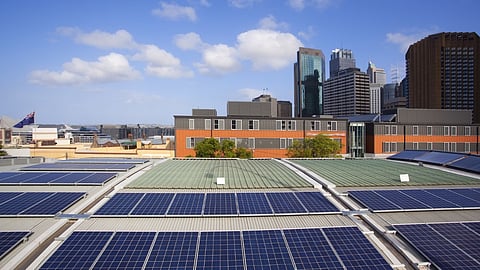


Australia plans to expand SRES eligibility from 100 kW to 1 MW for commercial, industrial, and agricultural rooftop solar
It has also proposed faster network approval processes to support greater commercial rooftop solar deployment
It aims to accelerate deployment across commercial rooftops, where only 5.6 GW has been installed compared to 22 GW of residential rooftop solar
Australia plans to expand financial incentives for commercial, industrial, and agricultural rooftop solar installations by increasing the eligibility limit under the Small-scale Renewable Energy Scheme (SRES) from 100 kW to 1 MW.
Chris Bowen, Australia’s Climate Change and Energy Minister, announced the measure, saying this support will enable more businesses to take up solar instead of fossil fuels and lower their energy bills, reducing costs for this ‘missing middle’.
Bowen said many warehouses, factories, and farming sheds have large roof areas that remain underutilized for solar generation because the current SRES threshold is designed primarily for residential systems.
This ‘successful and safe’ program has provided solar installation discounts since 2011 and has supported over 490,0000 battery installations since 2025, including over 50,000 batteries in Western Australia. Administered by the Clean Energy Regulator (CER), all installations under SRES generate certificates to be traded on the open market.
The expanded scheme is expected to reduce installation costs for eligible systems in commercial, industrial, and agricultural buildings by around 20%, according to government estimates.
Under the expanded rules, a 250 kW rooftop solar system could receive an upfront discount of about AUD 68,000, while an 850 kW installation could qualify for savings of around AUD 232,000. These systems could also help lower annual electricity costs for businesses, the minister added.
According to the minister, while residential rooftop solar capacity has reached 22 GW, businesses have installed only around 5.6 GW. He cited estimates showing the technical rooftop solar potential across commercial, industrial, and agricultural buildings could exceed 80 GW. “That’s an opportunity we should miss no longer,” stressed Bowen.
In addition to expanding the incentive, the government will ask the Australian Energy Market Commission (AEMC) to consider rule changes requiring network providers to process approvals for commercial and industrial solar projects more quickly.
“I want to end that road block,” Bowen said, referring to delays businesses have faced in obtaining network approvals for larger rooftop solar systems.
The expanded SRES will come into effect from October 1, 2026, once all necessary regulations are in place, stated Bowen.
The government announcement follows a recent Smart Energy Council (SEC) report that recommended raising the SRES threshold for the C&I rooftop solar segment – the missing middle – from 100 kW to 500 kW or 1 MW and speeding up grid connection approvals (see Smart Energy Council: Red Tape Slows Australia's C&I Solar Growth).
SEC Head of Policy and Advocacy Robert Potter welcomed the government announcement and said, “Commercial and industrial solar represents the generation capacity of ten of Australia’s biggest coal-fired power plants.”
He added, “This is how we power up all those untapped acres of rooftops without solar.”
