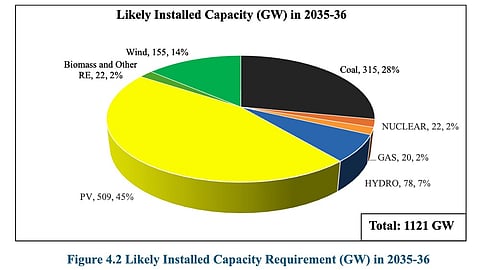


A new CEA report projects solar’s installed capacity to rise from about 141 GW in FY2025-26 to around 509 GW by FY2035-36
Coal capacity will increase more slowly, from about 228 GW to 315 GW, but it will remain the largest contributor to electricity generation with an estimated 51% share
India’s non-fossil-fuel capacity is expected to reach 786 GW or about 70% of total installed capacity by FY2035-36, supported by growth in renewables and energy storage
Solar energy is expected to become India’s largest source of power generation by installed capacity by the end of FY2035-36, according to a new report by the Central Electricity Authority (CEA). The report estimates India’s total installed power capacity will reach about 1,121 GW by then.
Solar’s share in the total installed capacity will rise from about 141 GW in 2025-26 (as of January 31, 2026) to around 509 GW by 2035-36. During FY 2025-26, solar PV capacity expanded by 34.95 GW, the highest ever capacity addition in a single year.
Coal, on the other hand, will see slower capacity additions growing from 227.83 GW to 315 GW over the same period. The 2 sources will account for 45% and 28% of the country’s total installed capacity, respectively.
Other renewable energy sources are also projected to expand: energy storage installed capacity will rise to 174 GW/888 GWh, comprising 80 GW/321 GWh battery energy storage systems (BESS) and 94 GW/567 GWh of pumped storage plants (PSPs). At the end of the projected period, India’s power mix will comprise 155 GW of wind, 16 GW of biomass, and 6 GW of small hydro.
Among other sources, large hydro will account for 78 GW, gas 20 GW, and nuclear 22 GW.
India’s non-fossil-fuel-based installed capacity will reach 786 GW or 70% of the total, rising from 52% in January 2026, while fossil fuels will represent about 30% of the share as compared to 48% earlier this year, as per the National Generation Adequacy Plan (2026-27 to 2035-36) report.
The CEA’s projections are backed by ‘complete visibility’ into capacity additions till the projected year. This includes 155 GW of solar, wind, hybrid, and other renewables under construction, 48 GW of renewable energy capacity under tendering, and 134 GW is planned to be added under the Green Energy Corridor (Phase III) scheme. Additional capacity is being planned and implemented at the state level.
Nevertheless, coal will remain the largest single source of power in the country as baseload energy during the transition period, according to the CEA’s report.
Coal will likely generate 1,819 billion units or 51% of the total power, followed by solar PV’s 984 billion units or 27% share.
The CEA says falling battery storage costs are making solar-plus-BESS a viable option for meeting electricity demand during solar hours and peak morning and evening periods. However, it adds that a reliable 24×7 supply still depends largely on coal-based power, which remains more cost-effective for base-load generation, especially at pit-head plants.
“Despite a relative decline in percentage terms, coal remains the primary backbone of power generation,” reads the report.
According to government projections, India’s peak electricity demand is expected to grow at a compound annual growth rate (CAGR) of 5.58% between 2024-25 and 2035-36, while electricity consumption is projected to rise at a 6.41% CAGR. By 2035-36, peak demand is estimated to reach 459 GW and total electricity requirement 3,365 billion units.
The report, the CEA explains, outlines a roadmap to meet India’s rising electricity demand in a reliable and cost-effective way, while supporting clean energy goals through a mix of fossil and non-fossil power and energy storage.
The CEA released the report at the Bharat Electricity Summit 2026, alongside the Transmission System for Integration of over 500 GW RE Capacity by 2030 report, which provides a blueprint for the transmission plan to integrate over 900 GW non-fossil fuel capacity to the grid by 2035-36.
Adding transmission capacity will be an important step to curb solar energy curtailment, as Rystad Energy’s Susham Jagannath, while speaking at the TaiyangNews Solar Technology Conference India 2026 (STC.I 2026), shared that India curtailed over 250 GWh of solar PV in 2025 owing to grid constraints (see India’s Defining Moment: Soaring Demand Meets Surging Supply).
